Wednesday, January 8, 2025

Worm Factory

Day two of the worm ranch reboot and I think most of the red wiggler Houdinis are settling in.  Hopefully this fulfills the requirements for the Beginner level Gaining Ground badge!    


I did/plan to do a few things the same: 

1.  Use Uncle Jim's as a supplier as we had good luck with his red wigglers in the past.  This box arrived really banged up, but the worms inside seem fine.  I had ordered through Amazon this time to get the farm and the occupants to arrive on the same day.  Probably would have been smarter to order them sequentially in case shipping delays left the red wigglers homeless.  Is there a good way to recycle these ubiquitous cheap nylonish "goodie" bag textiles?  I feel like we get a lot of them -- even from the FRB landfill!   

2.  Use shredded junk mail, school work, and to-do lists for our "brown" material.  I am now on my 3rd paper shredder, but have some tips from the reddit BIFL community about how to oil it every time I empty it and chose a brand with a durable reputation (Fellowes).  I haven't been super-selective about leaving out the glossy color printed material, but perhaps I should be.  The Factory came with a peat brick but the idea with this is not to add more complexity and extra inputs to our household economy and I'm not convinced that peat is a renewable resource.  


I did a few things differently to extend the longevity of this composter: 

1.  Bought a bin designed specifically for worms and frequently recommended by the reddit/vermicompost community.  I selected the Worm Factory because it looked most popular and closest to what we had been using with our old improvised system.  For perspective, the previous one had been plastic nesting totes with ventilation holes punched in it.  This did the trick, but got brittle over time, didn't drain as well or as conveniently as it could, and when full was a little heavier than what the plastic was specified for.  I appreciate the factory is black plastic which camouflages less than immaculately clean nesting trays.    I was intrigued by the Urban Worm Bag continuous flow system but had too many doubts about the tidiness of harvest and ability to monitor the health of the worms.  Maybe if we scale up we could experiment with that as a second system.  

2.  Positioned indoors in a more climate-controlled spot.  Previously, we had the bin on our back enclosed porch with a wall full of southern exposure windows.  It got brutally hot there in the summer and since it was close to our "main" door, we fielded a lot of questions about the unaesthetic muddy looking tote from house guests.  When fruit flies got into it, they seemed to quickly find their way into the kitchen and our countertop produce arrangements.  The new one is positioned in the basement by our overflow fridge.  This is still on a moderate traffic route to allow casual supervision (maybe even extra fitness, because I've taken the stairs a couple extra flights of stairs to check for drainage, escapees and share some tasty scraps).  Yet is much more "cool" climate year-round and not subjected to my weekly cleaning routine so I can tolerate it getting a bit messier.    

3.  Calculate volume of worms needed.  I used Appelhof's method to determine we throw off 11.2 pounds of kitchen scraps/week.  So I'd need 11.2*12in*12in = 1,612 square inches of worm space to process that.  My 14x14 trays can currently hold 784 square inches or 48% of that volume once/if worm populations scale up.  If I added 3 more trays to get up to the max 7 tray stack, I'd be able to handle 85% of my kitchen capacity.  We plan to continue to slow compost outdoors for the overflow.  Tamar Adler's Everlasting Meal book had a ton of recipes that reduce the amount discarded.  

4.  Gradually introduce worms to food.  In the previous bin, I would dump massive quantities in (orange juicing!) and have a boom and bust cycle complete with extra smell and overflowing leachate trays that were difficult to empty. I ordered a pound of worms so I can add about a half pound of scraps per day.  In 2 or 3 months (Mar/April '25), their population and throughput should have doubled.   June/July '25, around a half year from now, I'd be operating at full 7 tray capacity with 2.7 pounds of worm residents.  If all goes well.  I have some hints from Appelhof's book on favorite items of worms -- so far they have "disappeared" over-ripe strawberries, seem pretty happy with watermelon rind, and congregate in coffee grounds.  I'm holding off on citrus peels which seem aversive to Appelhof's worms, especially since our outdoor compost is orange tree-adjacent seems to have a lot of biodiversity to break citrus down quickly.  This has created an awkward dynamic of having 2 compost staging containers on the counter, but I think as the worms settle in, we will find a more streamlined process.  


To get a general sense for the whole system and coming attractions at the intermediate level, here is an overview:  

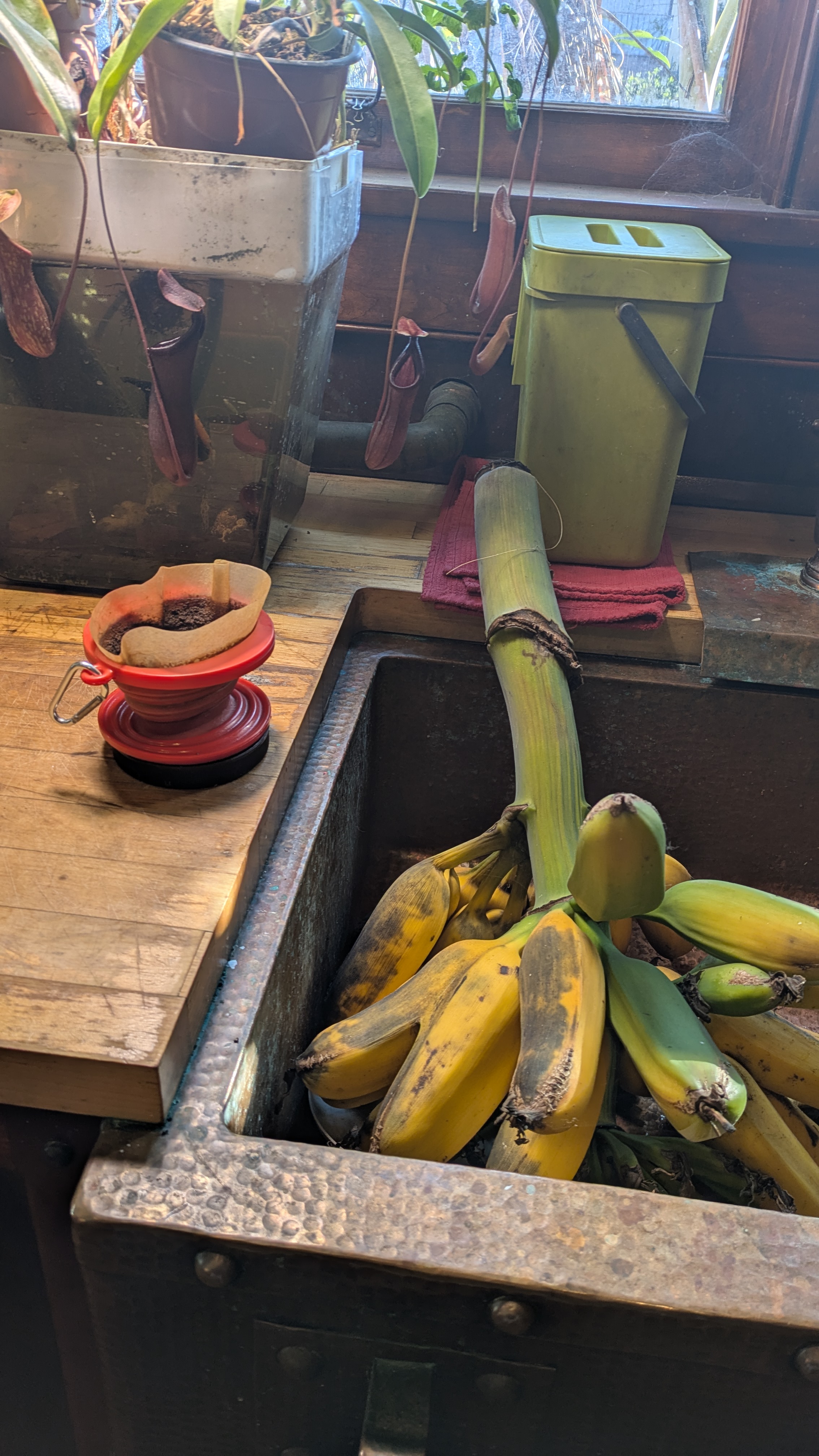
Kitchen sink green composting bucket-used to store under the sink in a cabinet, but that got so much use the door hinge was forever coming loose.  Also some choice worm scraps (coffee and bananas from our tree).  The contraption to the left is a fresh water shrimp aquarium with a resprouted celery stub and carnivorous pitcher plants in a grow tray.  Not central to the system, but showy and maybe they catch some fruit flies?  Pingula/butterwort would have been  more effective.    


Outdoor overflow.  We have been lazy composting into boxes, sometimes supported by movable dog kennel fencing for quite some time.  This box is overflowing and we have a second set up to go.  Ordinarily, I would not recommend composting against your house.  I was horrified one evening to look over my shoulder in my reading nook to see several roof rats scampering down the mesh screen that is compost pile adjacent.  However, I justify our approach for now because: 1.  we worked with a pest company to completely seal all exterior openings with the appropriate gauge mesh and have not seen rodent activity on the interior of the house.  2.  we have slowly gained the trust of 2 feral cats who patrol the grounds and sometimes leave us their trophies.  3.  this is a historic house and the soil samples I took at the foundation have very high lead content.  The guidance was either to dig out all the dirt, dispose of it somewhere (where?), and backfill with other dirt... or do your best to bury the lead under a layer of heavy mulch.  Since I don't plan to disturb these piles when they are finished slow composting in order to amend our garden beds, I am thinking of them as a very thick layer of mulch I am slowly applying around the perimeter of the house.  

Back to the worm factory.  

So far, my only modification to the instructions was to put a soaked burlap coffee roaster bag on top of the worm bedding because initially a half dozen or so worms wriggled/fell out through the roof/top in my repeated check ins.  I think this might have been a bit of shipping disorientation about which way was up (the basement lighting is really dim as well).  It might also be due to the the peat block which came with the kit still being a bit too dry despite my adding an order of magnitude more water to it than the guidance.  I've been continuing to irrigate it a little bit more on each visit and keeping the tap open at the bottom to know when leachate starts to run off.  

[day 4 update]-- Maybe that cheap nylon bag could work as a branded exclusion layer?  The burlap sack is pretty bulky and competing with space for scraps and I'm not sure I want to cut into it.  Still no sign of leachate, but the worms seem very active, fully rehydrated, and not interested in escaping.  I've stopped irrigating when I bring scraps and am thinking about bringing down more shredded paper for cover.  

[2/25 update] -- at some point a week or two ago, I overzealously dumped an entire kitchen waste bin into the compost and we have been combatting fruit flies.  I topped the 2nd tray up with a lot of paper cover to help.  Meanwhile, with our new outdoor cardboard box next to the disintegrating full box-- I was eating dinner with a view out the window these bins were placed under.  I heard a yelp, saw something that looked like a sparkler hit our window's bug screen and fall into the new bin I had freshly topped off with 4" of shredded vet medical records for Kai (RIP) and back tax filings.  By the time I got out there and hose-filled a watering can, making my way unluckily under the orchard ladder hubby had set up across the walkway to harvest bananas, the pile had a plume of smoke coming out of it.  Dispensing with the hose fill, I made two more runs to rapid dunk the can in the rain barrel that had filled in the only big rain we received this winter.  I think that doused it, I stirred it with a pick axe, contemplating my discarded Valentine's day rose bouquet garnishing the top of the pile.  I was grateful to have seen it happen to intervene as quick as I did and to have had the barrel of rain available.  But I think I might still be sleeping less deeply.   

[3/13 update] -- roughly 2 months after launch, still battling fruit fly clouds, but they seem to have dissipated a bit into the standing containers of apple cider vinegar.  I've got a spider which has taken up residence in the drainage mason jar that looks very fat and happy.  The drainage is starting to drain some worm tea which I've been pouring into a summer seed start sprouting tray that sits in a pool of water for irrigation/humidity.  I just topped off the second tray and added an empty third.  I peeked at the first tray which was a sight with lots of worm stalagtites crawling from the lower level into the second level.  We haven't harvested any castings yet, but this seems to be working well (minus the fruit flies).  

[5/25] 4021 grams harvested

[5/30] 1704 grams harvested
We noticed an increase in roach sightings and decided they were attracted to the basement compost.  It has been relocated to the front porch, outside "the perimeter."  The second harvest seemed a little too early, with a lot of residual worms.  

[8/5] 1119 grams harvested

[8/17] 1033 grams harvested
Noticing that avocado pits, avocado skins, and eggs don't really break down in here.  Maybe they would in a "cooker?" 

[9/17] 798 grams harvested

[11/7] 1205 grams 
A lot of this was sludge blocking the drainage spigot, but hosing the base off fertilized the fig trees.

[12/16] 2045 grams

[12/18] 2509 grams

[1/27/2026 ] -- 2749 grams today which should give us enough stats for a full year tally.  

In year 1, we harvested 37.9 pounds of vermicompost (17,183 grams).  

Since it was May before we began harvesting, keeping this going would generate 56 lbs/year.  The Factory should be able to hold 1-2 lbs of worms which google thinks should be able to generate 10-20 lbs of vermicompost per month.  The marketing on the website makes it look like we are operating wildly under capacity:  6.5 lbs of vermicompost/tray/week * 7 trays * 52 weeks = 2,366 pounds of vermicompost per year?!  Going back to the more conservative numbers, it looks like we are operating a little under 50% capacity.  

How could I bring that number up?   
1.  I leave the "done" compost to dry out in the sun sitting on the top of the factory for a day or two to encourage the worms to dive into the fresh tray underneath.  This makes the compost lighter for weigh in.  I could skip that entire step and in the process not obstruct the loading of that top tray.  
2.  I could route more buckets of kitchen compost to the vermicompost rather than the unmeasured slow compost.  Slow compost in the yard (glorified open-bottom and top Amazon boxes) seem to be the easiest on-going composting method for our family because it is less effortful. 
3.  I could schedule more frequent vermicompost emptying.  It looks like I got around to emptying a  tray about monthly, but I could speed that up to fortnightly and see if the material is ready.  I have some doubts about this because that would mean a tray has about 3.5 months of "dwell time" in the factory which doesn't seem like enough, particularly for avocados/eggshells, but I could be persuaded otherwise. 

Tuesday, January 7, 2025

Frank R. Bowerman Landfill


Yesterday, a classmate's dad hosted us at his work, the Frank R. Bowerman Landfill (11.6 miles).  This one isn't historic, per se, as it was established in 1990, but it is an integral part of our daily lives.  "We only close 5 days per year and stayed open as an essential service all during Covid,"  remarked Isaac.     

DH was jealous he couldn't get a peek behind the curtain because this landfill takes commercial waste haulers only.  His latest landscaping debris had to be driven all the way down to Prima Deshecha in SJC (27.2 miles).  A busy day for DH was two trips, the commercial haulers try to make 4, sometimes 5 drops at the FRB in a day.  These are massive semi trucks that dwarf the still substantial trucks that patrol residential areas.  These trucks deposit 11,500 tons of waste per day, netting FRB just short of a half million dollars per day in revenue.          

I was particularly interested in this excursion because I am starting the Cleaning Up badge sequence and, having lived in Irvine, I appreciate how particular the Irvine Ranch developers are about NIMBI considerations.  "We get about 5 complaints per year from the 'super smellers' who are in the new housing development on the other side of the toll road.  Always in winter, when there are temperature inversions, the days you may get "no burn" alerts because a warm layer of air is being pressed close to the ground and making everything smoggy."  This called to mind the introduction of The Lost Art of Reading Nature's Signs and Gooley's observations that during temperature inversions, you can hear train and traffic noise more loudly and even pick up on radio transmissions outside of your normal range (like behind the iron curtain during the Cold War).  

Isaac went on to elaborate the numerous mitigations in place to keep the complaints to a minimum.  There are hurricane fences with screens that match the landscape built to the perfect height to mask the volume of truck traffic along the roads.  These also catch fly away waste and have mister heads to suppress dust.  Every night, the exposed cells are covered with $30,000 of tarping to deter coyotes, birds, and smells.  The 22 megwatts of methane is sequestered "to power Disneyland" in Anaheim (or 14,700 average sized homes) or burned in flares when permitted.  The land run off is routed to basins and tested before any is released into the water table while leachate from landfill cells is collected in tanks for hazmat disposal.  "Usually this time of year, these basins are full," Isaac remarks wistfully as we drive by an empty cement divot and we say a silent prayer for rain.  Green waste is heaped in windrows to cook as compost for a quarter before being sifted and offered back to the public and public works projects at low or no cost.  "Most composting facilities operate on dirt, but we put ours on an asphalt pad on a 2% grade so we don't have pooling and smells, we pump the run off back up to these towers for fire mitigation and to continue to irrigate and turn the piles to keep them at 150 degrees."  They even have a biologist on site who has created a segment of the land that is kept native and introduced a wetland to protect wildlife.  This biologist also works with a paleontologist to determine if there are archeological finds that need protecting as multi-million dollar earth movers carve new cells into the canyon side and cover over the filled cells.  The lobby of the visitor center has a trophy case filled with mammoth and prehistoric river dolphin tusks and bones alongside Lunch at the Landfill and Dinner at the Dump gala invitations and numerous awards.     

Thinking about the sink holes I had read about along the California coast which had been drilled heavily for oil, I asked about subsidence and he nodded to a newly repaved section of the road we had just driven over.  "We get that.  Some older landfills have enough settlement that even though they are at the max altitude allowed, they can still stay open because of some settlement."  

"I come almost every week day, unless the waves are good..." quipped a deeply tanned Darryl, with Windy, a Harris Hawk perched on his glove.  "The crows almost know which days are the weekends."  Windy acts as a deterrent for birds which would come to pick over the trash, making it hard for dump trucks and machinery to see and operate and leaving droppings on the new housing developments full of super sniffers on the other side of the toll road.  "Harris hawks are like the Labradors of the raptor family, easy to train, hard to spook.  If she goes missing, she has telemetry on her ankle band and I follow it and put out her favorite toy to recapture her.  My Red Tail at home would never tolerate this..." he grins as my 6 year old reaches up to touch a feathered chest.  


Isaac also mentioned challenges on the horizon, even for a well-managed dump.  The leachate collected from the cells is removed by a hazmat company, which is better than older dumps which do not have liners to capture leachate infiltrating their water table, but I wondered how this company went about neutralizing the liquid.  He itemized materials that were pulled out for recycling like mattresses and household appliances and I wondered about how responsibly refrigerants were removed with the awkward handling of the forklifts.  He talked about cameras on trash pick up trucks that could detect, notify, and eventually penalize residents for improperly sorting their trash.  He noted that China no longer takes our poorly sorted recycling and that solutions have had to be cobbled together domestically, but it is hard to get them approved in California.  We discussed waste haulers who were understaffed and made the decision to combine pre-sorted residential green and household waste dumpsters to be able to complete their pick up routes.  "They aren't supposed to do that, but the directive is to divert 50% of green waste now, increasing to 70% in future years, so some make the decision to do it..."  But he notes that when the canyons are full, we might face $100 trash disposal bills like those of NorCal.  "We would have to rail-haul it inland to another state and that isn't cheap."  Current projections have this 725 acre canyon on track to close in 28 years.     

Sunday, January 5, 2025

Richard Nixon Library

 Well, I'll be pecking away at visiting the many historic locations within a 100-mile radius for a while. (Outpost 2.  Outstepping  Intermediate).  Here is a start!    


We took our Daisy Girl Scouts to the Richard Nixon Library & Museum (14.6 miles away) to earn their Democracy for Daisies merit badges.  

"I asked the docent to gloss over the war in Vietnam and Watergate!" my co-leader stage whispered before entry.  Amusing, as these were the most salient aspects of this particular presidency from what little I remembered of high school history courses and I was curious how the sympathetic docent would approach them.  But even the abbreviated tour was educational!  

First, I discovered that the flags were flying at half mast because Jimmy Carter had died last week at 100 and would continue to fly at half mast during the next president's inauguration.  The docent speculated that Jimmy's body would probably be moved to the Carter Center to take advantage of federal security (at which point I studied my shoes, having nearly smuggled a pocket knife into the Nixon facility).   

I didn't realize that every president since Hoover has established a presidential library.  I didn't realize this library is the second most popular place in the county to have a wedding, with its terraced library of roses favored by each first lady.  If I were first lady, my selection would be problematic-- miniature or black?      

They had a wonderful model of Washington, D.C. that laid out the branches of government buildings (White House, Capitol, and Supreme Court) in a way I had never appreciated in my childhood visits from Maryland.  I want to go back to visit to see the cherry blossoms and rediscover the non-descript grey Smithsonian galleries.  

They had replicas of several rooms in the White House and it was so fun to see the girls behind the big desk in the "oval office."  

Title 9 and the EPA were established under Nixon.  A few rooms later, the docent shared "Nixon loved reading by the fireside so much, he would have his aids turn on the AC so he could sit next to a stoked fire and read even in the middle of summer!  When the next administration began renovations, they could see the stain his pipe smoke left on the ceiling over this chair!"  We are all a bundle of contradictions, aren't we?  

We saw Nixon's childhood home which had not been moved, just supported with a foundation and Nixon's burial site just a stone's throw away from the back door.  Things come full circle.     

Thursday, January 2, 2025

Trans-Catalina Trail Recap

That was fun!  


12/27/24:  Me and my 2 hiker buddies (Kim and Frank) grab burritos in Avalon at sun up and begin the 10.8 mile mostly uphill hike.  Hermit Gulch campground is a ghost town-- it wasn't "full," it was closed for the holiday.  When we reach the ridgeline, I feel pins and needles of mist-rain on my hands.  This continues for 3 more hours and we abandon our plans of leisurely hot lunch at the park by Haypress reservoir (we arrive at it at 9AM anyway).  Instead, we dine on a mouthful of protein bar and Kim captures a couple photos of 2 loan bulls hunkered down on the hillsides.  Instead of putting on my poncho, I opt for my trusty Pata fleece which is cozy at first but in retrospect a mistake.  Mud accumulates in heavy clods on our shoes-- a phenomenon I only encountered once while training.  When we arrive at Black Jack campground around noon, we are completely soaked and for the first time in over a decade, my fleece has an odor.  We mutter a few words of gratitude for the sprawling oak cover and the high ridge windbreak features.  Then outside of a hasty jetboil meal and a sighting of two mule deer and a fox, we huddle in our tents waiting for the rain to stop, trying to dry our clothes with body heat, and fantasizing about hailing a cab from the airport in the sky the next day.  Thankfully, the temperatures in Catalina don't dip so low that hypothermia was much of a threat.    


12/28/24:  At daybreak, it is still overcast as we put on our wet (stinky) clothes and book it the first quarter of our 8 mile hike to get to airport in the sky.  I'm so glad I ran some shock cord through the contact points on the back of my pack so I don't have to stuff that wet muddy mess into the pack but just lash it to the back.  I'm usually plant-based, but this day called for a bison burger while admiring an impressive taxidermized shoulder mount of the same over a faltering fireplace flame and some supplemental hot chocolate.  We stay here 3 hours, waiting for our gear to dry, the sun to come up, and for me to stop making stupid moves as I learn 3-hand euchre.  I understand a bit of the camaraderie described in through hiker travelogues now as we meet most of the hikers following a similar itinerary and learn a bit of their backstory and will see them again in 2 Harbors and along the trail.  By afternoon, we are ready to finish the last 6 miles of descent into Little Harbor/Shark Harbor.  We see a herd of 12ish bison we dub sausage fest because we don't see babies but learn from a guide friend later that this herd was mostly female.  Shark Harbor is as far off the TCT as I could have gotten, but I make up for it with the PB cup s'mores and an adult beverage I packed in.  


12/29/24:  Another big climb day, but only 5.4 miles into Two Harbors and an hotel that boasts wine and cheese hour.  We get the closest we have ever gotten to a loan bull on the ridge line on the way.  Banning House was definitely worth the upgrade over the campground.  They have the best chocolate chip cookies on the island and a really cool lodge great room/library that my cell gets some signal in.  The groundskeeper worked at the same obscure Alaskan fishing lodge my buddies just returned from, so they spend most of their time comparing notes.  We take long hot showers, dump an entire mini Bronner's soap bottle into the laundromat washer and adjourn for more burgers, brew, and euchre.  At dusk, we meet Jasper, the unusually friendly fox and an unusual raven-pigeon cartel.  


12/30/24:  Slack packing with just a stove, 3.5 liters of water, first aid and rain gear on a 14.5 mile loop out to Parson's beach for lunch and back.  The beach campground is deserted when we arrive and the leftover water jugs are plentiful (but what we carried was more than sufficient).  We have Frank pose next to the scout camp he attended 40 years ago and count the 11 inlets we need to trace to get back to 2 Harbors.  We hang with 4 Catalina employees, the only other guests at the Banning House, in the great room that evening.  3 of them recognize us from leading tour groups through the airport 2 days ago or serving us burritos in Avalon.  Small world.    


12/31/24: Our cab picks us up to take us back to Avalon and gives us a tour of back roads on the way.  We have brunch at the lobster trap, do some souvenir shopping and more euchre in a biergarten before heading to our respective ferries.  


So yeah, that went well!  

I used just about every piece of gear I packed (outside of first aid kit)-- maybe I didn't need the extra backpacker meal, protein bar, and piece of pita bread but could have easily consumed it and more in 2 Harbors if Kim and Frank didn't insist on picking up the tab on dinners at Harbor Reef to pay DH back for taking them on a fishing trip.  If I weren't smuggling gentleman jack, I would have swapped its weight for a travel size deodorant stick, but settled for spraying a bunch of lavender hand sanitizer on everything and making sure I did a bandana bath in the tent every night before changing into my dryish-cleanish sleep clothes.  My pack weight was 22.5 without any water bottles filled (18% body weight).   

I don't *think* I was boring.  It would have helped if I were a better cards player.  I think Kim and Frank were spooked by my sobriety streak but the 2 Harbors general store seemed to have an endless supply of 0 gravity Heineken so we found a way to not make this an irreconcilable difference.  

Being uncomfortable was a thing with the soaked start, but I got to test all these truisms about wool and fleece keeping you warm even when they are wet.  The switchback camping pad never created a hugely restorative night of sleep (even with a valerian tea and 2 tylenol PM), but with only two nights rough, it didn't compromise my mileage that much.  

Shark week was pretty much right on schedule and my triple play (tampon, pad, period underwear) was plenty of coverage.  Maybe some day I'll get back to experimenting with diva cups, but it is unlikely I'll need one to do long excursions before going menopausal.  

The house was in chaos when I got home, but the kid and dogs were in good shape, which was all I expected DH to do.  He also did some major yard landscaping for extra credit and planted a potted citrus Christmas gift for me.    

The one area that surprised me was how little time in the total day we spent hiking-- 2.5 hours to 5.5 hours/day.  If I were planning another excursion for myself, I'd want to see if I could push the mileage a little higher.  I would put more thought into arrival and departure times from campsites and how they would work with meal times.  But now I know that if climbs are involved, my average pace is 26ish min miles and if it is flat, plan for more like 23ish min miles.  

I'm tempted to consider doing a longer excursion with fewer hotel stops, since there still some leveling up to do in terms of quickly breaking camp and packing equipment in a way that makes it easy to set back up (i.e. wet tents).  


Monday, December 23, 2024

Trans-Catalina Trail Prep

[Outpost, 2.  Outstepping] [Make it Easy, 7.  Let's Get Physical] series

Just 2 days from the 4-6 day Trans-Catalina hike!  (40 miles across Catalina Island, California)

My bag is packed, aside from daily electronics and fridge pita.  Now that restless sense of disorganization sets in.  I thought maybe a blog post would have a calming effect, or at least amuse Future Me in retrospect.  

Sunset over my 1 person tent that took 2 people to set up on hard-packed Lower Moro Campground


Party:  Historically, I have been a lone adventuress, assuming that no one enjoys my company or brand of masochism enough to tag along.  This time, MIL encouraged me to invite SIL and DH made enough rumblings that our semi-annual friends might be interested.  As luck would have it, they all wanted to go!  What other adventures have I been too shy to make co-operative activities?  Sadly, SIL dropped in the final stretch with a back problem, but I was so impressed with her on the Moro Canyon gear test overnight.  How did she track down such a respectable kit without blowing thousands at REI?  I need to consider if I can borrow equipment for future projects rather than being such a quick draw with the credit card.  Hopefully the homework her PT gave her speeds her recovery.    


Itinerary:  I stole an itinerary and max budget from an REI excursion.  $2,699 to rough it?!  Plus the gear sherpa, meals and outsourced planning felt like it would rob some of the fun and sense of mastery out of the undertaking.  Then I bought a TCT book to study thoroughly only to ultimately arrive at the same REI itinerary.  Thankfully, I now had recruited project manager guru Kim to my party to sanity check rules that had changed, glampy hotel and restaurant alternatives to full campgrounds, feasible ferry schedules, and generally make sure I executed the prep I had vaguely vowed to do.  

12/26 [Thurs] - Arrive Avalon, check into respective hotels (Seacrest), check in with Catalina conservancy on our hiking plans, meet for dinner at M's, rest up and charge electronics.  

12/27 [Fri] - pack up with easy access hummus snack and water bottles filled, meet at Kim and Frank's hotel bistro for burritos and coffee, and get a start on a 11 mile of big rolling hills day, fully loaded to Black Jack campground (BJ01).  

12/28 [Sat] - Leisurely decamp from Black Jack to stop for brunch at Airport in the Sky for notoriously tasty bison burgers (locally sourced?) then continue the 8 mile downhill to Little Harbor which is touted as the most worthwhile campground on our itinerary (Shark C).  Try not to think about how much more epic this would have been if DH had managed to boat camp and support us with DD.   

12/29 [Sun] Determine when to decamp for 2 Harbors as it is only a 5 mile hike and Banning House Lodge check-in is 4PM.  That said, this would be the opportune time to try to run a load of laundry at "the restroom" I had contemplated when booking a placeholder cabin in 2 Harbors campground and do some town shopping.  

12/30 [Mon] leave the tents and make an early pitch for Parson's with a relaxing lunch there to celebrate having arrived.  Then hustle back to 2 Harbors in hopes of arriving before the restaurant closes.  14.5 miles.  

12/31 [Tues] clean up and catch a cab back to Avalon and from there, civilization.  

Planning:  We built a google drive doc with our itinerary and packing lists.  This was enough to get us to the Moro Canyon gear check campout.  This is my nerdy favorite aspect of camping -- finding the most minimalist/lightest/cheapest/multi-purpose things to pack.  The dopamine jackpot is finding that thing that breaks the "functional-light-cheap" tradeoff, like substituting smartwater plastic bottles from Target instead of an ancient leaky camelbak or a fresh new bamboo toothbrush instead of a mildewing plastic travel one from the Before Times.  From there, I took the shakedown concept even further with a lighterpack list which I compared to other Trans-Catalina posters on the ultralight subreddit.  This was constructive.  I discovered my base weight isn't that brutal vs bodyweight (22.5-30 lbs, 18-24% bodyweight depending on water carried).  I also learned to start appreciating things I considered necessities (stove, meals and snacks, a tent) could be considered luxuries for more light-headed folks.  

Meals:  A close second favorite aspect of camping because of the "good-light-cheap" breaking potential is meal planning.  The redditors were euphoric about Mary Jane's Farm but pretty much everything was out of stock while they refactor this business (this launched a wonderful side quest into joining the sisterhood and reading the books).  Outdoor Herbivore was next best, though it didn't taut organic anything.  I ordered 2 mac 'n 'cheese'  not fully heeding the implications of the scare quotes and found the test batch at LM campground was very nutritional yeasty,  a Pac Trail vinagrette which reconstituted surprisingly well and could work as a no-cook lunch break but wasn't mind bogglingly good (the marmot that rushed under the table to appropriate a fallen broccoli begged to differ), and dehydrated hummus which was both cheapest and most impressive-- a definite no-cook lunch option.  I also bought some clear boil bags for diy and was relieved I did because my concoction in the repurposed mac 'n 'cheese' continued to wreak of yeast.  

From there, I moved into this wonderful reddit thread and have been revising their classic beans and rice recipe with my camp stove from the comfort of my driveway.  Mine has powdered cheddar because we still had some left over and real cheddar seemed messy to clean up, some extra flax meal (fiber).  These run an impressive $3.72/meal vs $12 for an OH prepack.  These aren't strictly organic as indicated for Outstepping Expert level, so I will look for organic instant rice and dehydrated beans (or try MJ's fave quinoa for days hack and diy dehydrated beans).   

For TCT, I've thrown my lot in with as yet untested OH Basil Walnut, OH hummus with pitas, 2x beans and rice, a chia overnight soak (with raspberries I dehydrated after reading about it in MJ ideas book), a couple protein bars, beet chips, roasted edamame, LMNT, instant coffee, espresso beans (1/mile), gum, and s'mores fixings.  This looks like a lot listed out, especially when also planning to avail ourselves of restaurants in town...  I keep thinking of that Patagonia quote-- "The more you know, the less you need."  How little I know.  

Training:  When I started training in earnest, I had resubscribed with my old triathlon trainer to get ready for HIM Oregon (the true expert level 7.  Let's Get Physical challenge).  She had experience training athletes to Rim2Rim the Grand Canyon that she ported over for the TCT.  This is my 2nd month of almost complete adherence to her cardio and strength plan (I substituted one run workout for a comparable stationary bike and did 2 extra credit strength sessions).  Take that!  Let's Get Physical Beginner Level- set exercise goals and stick to them for a month.    

Prior to her input, there was a lot of summer rucking with increasing numbers of water bottles for resistance on days when I could drop DD in a camp and into the days she has in-classroom instruction.  I had recruited Kim and Frank to join on one hike that, without any preamble went up the most wicked climb I could find in any online trail selection site, just to assure myself it was doable without hazarding missing a school pick up.  That might have been when Frank and Kim's training began in earnest.    

Coach Ingrid's plan eventually persuaded me to splurge on a Parks pass and put in some long fully loaded hikes in Moro Canyon after our practice overnight camp.  2 were 9 milers, with 2 clocking in at 4.5 or so.  These day hikes could qualify for the Outstepping beginner-visit three places you've never seen before because I managed to find all 3 back country camp grounds in the park and hike 5 trails I had never been on.  Deer canyon was my favorite campground, it didn't have expansive coastal views but felt so secluded under towering oaks with a dry creek bed running alongside it and since getting there required a single track trail rather than fire roads, it seemed to have potential for more solitude.  These training hikes were good for testing food, water consumption rates, and different gear configurations.  I am still not a hiking pole convert-- if they weren't necessary for my tent, they would be the first gear I would ditch.  

My favorite memories of these training sessions were 1.  managing to get the radio to work and hailing my MIL, DH, and DD on the catamaran in the bay and hearing my kid squeak "Hey, Mommy?  What's your 20?"  (I had to google what my 20 was later when I got back in cell range).  2.  Searching for the eerie distinctive "footprint" my brand of Altra trail shoes leaves in the dirt roads I knew I had never walked.  There was also a misty day where I got a face full of what I think of as eau d'creosote but might actually be damp sage of desert after rain.  Either way, I wish it could be bottled, intoxicating.  

Gear Check: A little over a month out, Nov 16, we 4 hikers loaded up packs to camp Lower Moro backcountry campground.  I had timed it so we would arrive at about sunset, having camped the Upper Moro ridgeline in summer and finding it brutally hot in the afternoon, not an ideal place to hang.  Sadly, LM was a much more popular destination and so even though the booking tool made it look empty, there was barely any flat ground to pitch one tent let alone our 3.  I was uncharacteristically grateful for Frank's curmudgeonly demeanor that evening because eventually a solo backpacker took pity on us and let us have the bulk of his area (if only to put an end to Frank's indignant muttering).  

It was here I learned the wonders of backpack strap water bottle holders, jetboil stoves and how tippy cooking on picnic tables could be.  Low-key envy can be a pretty good indicator of what areas of your kit (or life) could use an overhaul.  I also worried I might be a pretty lame hiking buddy because it got dark early and we pretty much all turned in.  What we lacked in plush mattress oblivion, we made up for in total hours of shut eye attempted.  


Death grip on my eternity-to-boil stove after half the water I packed in catapaulted off the wobbly picnic table creating this lovely mud feature and soggy bench I am hovering next to.


Budget:  REI offers this experience for $2,699.  This wouldn't have included Express ferry or restaurant splurges.  I'm chuckling at my TCT book's suggested budget of $254/person.  Our bill is going to land closer to the REI price point but we sprung for a lot of glampy upgrades and the author assumed you had a complete kit.  

$132. Cata express (commodore lounge for priority seating and snack)

$157.12 campsites (2 people--so with omniscience or lots of chutzpah, I could try to clawback the amount for Judy-- but it's a good cause)

$35 conservancy membership  (not mandatory and while it says it offers a discount on campsites, I didn't pursue this either, it just seemed like a relevant charitable contribution)

$38 switchback sleeping pad 

$217 (86.09 after gift card) 2x darn tough socks, knife, fuel, spork 

$106 outdoor herbivore

$212 seacrest inn

$581 banning lodge

$25 Morro campground for gear check (but Kim reimbursed me almost the full amount)

$195 state parks pass (not necessary, but helped motivate me to do the extra 5 long fully loaded hikes on comparable terrain)

$130 jetboil gift (technically already had a serviceable stove, but this is so much better designed it sips fuel)

$60 backup tights, fuel can, marshmallows 

$100 lip protectant ($6), possums gloves ($28), wool gaiter ($22), flat water bottle ($15), blister first aid ($12), Leukotape ($9), Target smartwater bottles 

So that prices me out at about $2,000 before the restaurant stops and other incidentals.  Which seems like a fair deal in that there are new items I plan to wear weekly-monthly (gaiter, gloves, socks, tights) and upgrades to my camping kit (jetboil, spork, pocket knife) and a parks pass that DH has big diving plans for after the lobster season wraps up.  

Frank was joking we hadn't seen much wildlife on our hike, but we turned a corner and stumbled upon this taxidermized display as we exited... 


Worries:  what am I still anxious about?  

Being uncomfortable-- will it be cold, hungry, bored without devices, will I have to do the majority of a 10 mile hike needing to poop? 

Social anxiety-- Am I boring company?  Will I be self-consciously stinky?  

Body composition going in the wrong direction-- my weight is up 10 lbs since the notes I was taking this time last year.  Sure, I've been moving and lifting more, but I don't think it is all muscle.  I left a shirt in the REI dressing room because the muffin top situation it accentuated was startling.  What will the stats look like after an uncharacteristic number of meals out?   

Shark week.  I have no experience with managing flow in back country--hygiene logistics, the cramps that can present as hunger or as coming down with a cold, and the generally not feeling in peak fitness state.  

DH solo'ing the kid and dogs for that long, that is a different kid of endurance he hasn't been training as much for.  How detailed of a to do list does he need? 

Worry worry-- am I worrying too much?  or about the wrong things?  how much of this detail can/will/should I remember?  I feel a bit less present in all the holiday festivities.  Or daydreaming too much about how to up the ante and do Rim2Rim next...   But looking over this list, the rational side of me can't think of anything more I could do to mitigate my concerns, so here goes nothing!  

Thursday, December 19, 2024

Garden Gate 3. Gaining Ground

Our last vermi bins worked ok but they were plastic totes with air holes drilled it them.  They didn't drain perfectly and what they did drain was annoying to siphon out.  Fruit flies were always an issue.  The plastic eventually got brittle and deteriorated.  So we have taken a couple year break from this operation, but the kid is fascinated with bugs and crawlies and I've managed to keep a couple carnivorous plants alive indoors, so it might be time to get back into it.  

I've just finished a library copy of The Earth Moved and before that, Worms Eat My Garbage.  The former was much more practical.  I have a copy of Secrets to Great Soil for Expert level but haven't cracked it open yet.  

Appelhof's first tip was to weigh your kitchen scraps to get a sense of how much worm food you generate.  I'm posting 3 weeks of home compost weighing.  This covered Thanksgiving and the run up into Christmas with a big banana rack coming ripe in this interval so this maybe slightly more bountiful than truly average.  That said, we generate 11.2 pounds of compost/week.  So we'd need a system that is about 11 square feet with 11 pounds of worms in it to process all of that.  I have my eye on a Worm Factory but am waiting until the Christmas and through hike settle us back down to a routine.  I'm not sure one system would fully cover the load so we may continue to slow compost in the yard.  


Sunday, December 15, 2024

Fairy Gardens Brain Dump

From: Gardening in miniature: create your own tiny living world.  Janit Calro.