Showing posts with label CU. Show all posts

Friday, February 27, 2026

Path to Zero Waste

 Research zero-waste living.  

Original resource link was broken, so I read A Year of No Garbage.   

Find out what a waste audit is and why you should perform one to start your path to zero waste.  (discard studies link)

1.  Find the edges of your study. Choose a timeframe and a location for your audit

I set out to measure all the recycling and trash I collected during a one month period (Jan 2026). 

Out of scope:  

Itemizing types of recyclables-- I went by gross weight, but if doing this exercise again, it would be constructive to audit just my recycling and trash with a category for "trash plastic-films,"  "recyclable plastic," and "other" (aka glass, aluminum).  

Compost.  We already compost and shred our junk mail into a vermicompost.  I worried that weighing it would discourage me from continuing the habit.  

Blech unhygienic items:  flushed or not washable to go in the gather pile.  Containers which could be rinsed were in scope, but things like the odd wet wipe (though I primarily pre-game with a bidet) in the bathroom trash, or used strings of activated charcoal dental floss (in a sustainably grown bamboo container) went out without itemization.  Schaub had a similar rule in play in her Year of No Garbage book.  

Items accumulated In Transit.  I tried to limit eating out and pack back home the wrappers of the occasional excursion, but it would have been infeasible to do this on an international trip or in some circumstances.  In those cases, I commented and reflected in the daily log on items I had not captured.  For the days we were on holiday, I tacked on extra days into February to amount to a full month.  

Husband purchases.  These are difficult to have much influence on while maintaining domestic tranquility.  We have different levels of commitment to reducing waste, so I would do what I could to restock items he uses to pre-empt a purchase and sort items he had categorized as trash (or items he felt were recyclable that my research indicated would contaminate the process) where it was easy to do so tactfully, but I generally left his business alone.   

Semi-in-scope?  

Kid items I was complicit in purchasing.  Initially, I planned to focus just on my personal waste stream, but over the course of the month, my conscience nagged at me.  I found I was increasingly counting convenience food items I purchased and prepared for her in my waste stream, but did not do this consistently throughout the month.  

2.  Collect that waste! 

My trash audit was logged on this blog post. 

3.  Categorize and count your waste. 

13.2 lbs recycling, 4.3 lbs trash photographed and weighed for the month.  For the full log see this post.  

How is your waste different from your city’s waste stream (see their annual reports)? Why?

This was surprisingly low, with the trash gathered in a month amounting to slightly less than what some sources say the average American produces in a day (4.9 lbs).  With 3x more recycling than trash by weight, it seems like we are already making some more sustainable choices.  Even so, I'm a little discouraged that I generate almost twice my body weight in trash and recycling per year even while on my best behavior during an audit.  

I think our waste was different because we already compost, shred junk mail, and have tackled the "low hanging fruit" for decreasing waste over the last few years, like working with a donation pickup service and ewaste recycler.  I also knew we were doing a trash audit, which changed my behavior-- I wasn't as likely to embark in a big decluttering session if I had to weigh everything I pitched.  

What is the largest category of what you throw away?

The most common/galling categories of trash were (1) plastic food packaging, even for whole unprocessed foods and (2) packaging from mail-order purchases.   

How much of your waste is preventable, and how much is not? Can you actually prevent the preventable portion of your waste? How?

Food packaging-- we already prevent a lot of it by limiting eating out and bringing a cup for coffee shop stops.  I try to select bulk sizes and paper wrapping options where available (i.e. flour) because these can be shredded and generate less packaging per unit.  To go a step further, I would keep a separate shopping list for produce and bulk goods I could buy loose and scoop into my own reusable bags rather than combining these with a single drive up delivery order.  I have tried purchasing these at a local farmer's market and come away with less packaging, but find the prices are generally higher than what is available at the grocery in the organic section so save these excursions more for intelligence-gathering about what is in season locally and one or two really good deals.    

Mail order packaging-- this is the hardest to control.  I already do what I can to purchase common products at the grocery/local store rather than ordering them online.  When ordering online with Amazon, I select the "eco" slower shipping that promises to combine orders.  I try to save my online shopping for a single day of the week to further consolidate my purchases and the packaging they require.  Most durable items I try to buy used/refurbished and think I am mostly shopping to replace completely worn out items rather than seasonal decor and fast fashion experiments.  To go further would be to spend more time working on anti-consumption goals, like participating in a Buy Nothing Group.  I could also write letters to online shippers requesting non-plastic packaging.  

How much of your waste could be diverted from the trash to other destinations, like recycling, composting, or reuse? Would the biggest category in your audit be impacted by diversion?

We already do a lot of composting and recycling.  We usually use up our consumables and wear out the durables.  There were a few items we donated (i.e. pants with rips) that I could have gotten handier at patching, but told myself "if it is ripping here, it will rip elsewhere soon."  It seems like to cut waste further, we would need to cut back hard on purchases and focus on "making do."  

How is your waste specific to your local place and culture?

We are in a parenting hustle season, so some of the areas we continue to be trashy are because doing so is logistically convenient or expected in group gifting/potluck/school lunch settings.  We don't want to have to explain ourselves, deplete limited time or energy, or have our kid feeling like a weirdo.  

Where in your building, town, campus, etc, is the most trash created? Why? Can that be changed?

Most of our trash goes into our kitchen waste bin since this is where we spend most of our time and meal prep generates the most trash.  The bathrooms throw a tiny amount of waste (i.e. dental floss, non-flushable wipes).  

I keep our hamper for donations in the closet because it is close to our "not playing with" parking lot (under the bed), worn  out/seldom used items in the closet, and it is out of view of our kid who would otherwise rifle through it.  


Think of small, yet meaningful, ways you can reduce your waste and implement them into your daily routine. For example, instead of throwing away kitchen scraps, re-grow veggies, and think of ways to reuse or repurpose things that would otherwise be disposed of. [Expert]

Here is a list of 30 things I could do to reduce waste based on this audit.  I will strike out the ones I have already implemented.  

1.  Schedule a reminder every January to do another trash audit.  Next time I will measure the plastic materials specifically.  

2.  Do a no/low-spend challenge to reduce the amount of mailed packaging.  

3.  Add farmer's market to the family calendar on the fortnightly day when the salsa vendor and the honey vendor are there.  

4.  Go to the farmer's market!  Bring reusable produce bags and a price list for what the grocery cost for seasonal produce would cost for comparison.  

5.  Craft more produce bags so you don't run out on a shop.

6.  Split some grocery drive up orders when scheduling allows.  Personally shop the produce/bulk list with reusable bags when you come for drive up.  

7.  Start a list of home-growable produce, to further reduce plastic packaging.  Bring with when visiting the nursery.    

8.  Trial large bulk order (i.e. Azure Standard) for dry good staples (flour, rice, beans, etc.)  Keep track of date product started to better predict how much and how often to restock. 

9.  Continue to experiment with lower waste make from scratch convenience food copycat recipes (mashed potatoes, acai mochi)

10.  Schedule online shopping for a single day per week [Mercado Miercoles].  If you order something on a different day, keep a journal of what it was and why.  

11.  Write a letter to your favorite online seller requesting that they offer an option for non-plastic/low packaging shipment that you can opt into.  

12.  Review shipments when they arrive with a specific comment on the quantity and plasticity of the packaging.   

13.  Stash a box cutter close to the recycle bin  to encourage breaking boxes down for proper recycling

14.  Keep a spending journal for a day/week/month with reflection questions (i.e. need vs want, borrow/buy used options researched)

15.  Post an item endorsement on BIFL (buy it for life) reddit 

16.  Post something constructive on Anticonsumption reddit

17.  "Re sort" an item the family mis-categorized into the appropriate trash/recycling/compost category

18.  Experiment with a countertop compost cooker to see if this improves breakdown of tougher items (eggshells, avocados, pits)

19.  Line dry a load of laundry to reduce dryer lint

20.  Schedule a washcloth/reusable rag purchase with every empty paper towel roll collected

21.  Donate a diva cup, bottle bidet and other new period gear to a shelter "staples" drive to decrease amount of disposable sanitary trash

22.  Ask preschool if they would like a wormbin and help to set it up

23.  Work on the homespun Christmas badge and find ways to whip up gifts/hostess consumables that are low/no packaging (i.e. mason jars, pyrex jars, reusable advent calendars, bath bombs, massage bars, etc.)

24.  Complete Goodwill service patch with daughter to recruit another helper in our 6 times/year pickup please donation contribution. 

25.  Buy a set of reusable ziplock bags for every empty box of disposable film we empty

26.  Invite friends to a picnic instead of meeting at a restaurant

27.  Request to be removed from a catalog mailer I do not browse.  Use a box cutter to remove the spine and shred the remainder.  

30.  Visit Northgate to investigate lower-packaging for Mexican staples (dried chilis, beans)

31.  Get a set of reusable plates/utensils/cups for the scout troop to reduce waste at meetings

32.  Buy "sticky" condiments (i.e. PB, nutella) in a glass bottle that is easier to clean than the plastic if making from scratch is too tough

33.  Post a request or an offer on a buy nothing/craigslist group

34.  Buy 2 copies of No Garbage book and sock one away in a free lending library

35.  Save "compostable" baggies from produce and find a way to install mini-trashcans they could line in the bathrooms now that we have worked through our plastic film bag liner stash

36.  Invest in cloth napkins and figure out how to fold them into cute lunch box critters.  

Tuesday, September 2, 2025

Leave It Better Than You Found It


Why is stewardship of the Earth important to you?  

My brief career as an Insta influencer was spent documenting the items that materialized overnight on our sidewalk with the hashtag "trashfairies."  The thing about trash fairies was the quicker you responsibly disposed of their treasures, the less likely they were to leave you extra.  Stewardship was initially an act of self-preservation, lest we take a peek at our sidewalk one day and find a Sarah Cynthia Silvia Stout-sized berg leaving us no hope of driveway egress.  Now that I'm a parent and deadpan insisting that the tooth fairy doesn't pay as much for teeth with cavities, I find Earth stewardship has broadened into a general concern about legacy.  Last I checked, our short-term odds for planetary egress weren't that great.  I want my epitaph to read, "She left it better than she found it."  

Why is it important to keep our highways, public places, and outdoor recreational areas litter free?  

My top 2 reasons for keeping areas litter free are:  

(1) Litter eventually ends up the ocean where it contributes to all the microplastics floating around in the continent-sized garbage gyre, poisoning wildlife and eventually poisoning ourselves. 

(2)  No one wants to spend time in ugly spaces.  Research says spending time outside makes us healthier.  Why not do everything we can to Make Outside Attractive Again?    

What adverse effects can the presence of litter have on the environment and wildlife?  Tell us about these problems in three different areas of the world, such as roads, nature, waterways, urban spaces, etc.


Urban:  Provides harborage for pests.  Mosquitoes can lay eggs in the amount of water pooled in a discarded soda cap.  


Roads:  Litter can block storm drains and increase the risk of flooding.  It can also create accidents if it causes drivers to swerve to avoid it.  


Waterways:  Litter that washes out to the ocean can harm wildlife.  Plastic bags look like jellyfish, a delicacy for some turtles.  


Waste Removal Sorties:  (intermediate level)


1.      12/14/2025 – Nurdle patrol beach clean up-- No nurdles found but lots of styrofoam!  We were even gifted more beach trowels and buckets by another family on the way out.  


2.      12/25/2025  - around the block walk with grabbing sticks


3.      1/21/2026 – around the block with grabbing stick, lots of broken bottles and some recyclable! 


4.      2/11/2026 – around the block with grabbing stick


5.      2/25/2026- around the block and found a discarded scooter


Wednesday, July 16, 2025

1. Line dry laundry evolution [Expert]

7/14: Embark on my first "full" line dry hang...  I pick an auspicious, misty and overcast day for it, but the sun eventually dries everything out.  

I should time this approach vs. the dryer approach since it feels more tedious but I couldn't quantify by exactly how much.    

This makes me extra motivated to reuse towels rather than getting fresh ones.  They use up so much real estate on our line!  They dry a bit stiff but no family members have complained so far so no need to fall back to plan B (short dryer air fluff).    

It also motivates me to continue to shift my "uniform" over as much as possible to fast drying fabrics (bike shorts, hiking paints, swim tops).  Also to pieces multiple times if they are serviceably clean.  

I should buy more kid-sized hangers for kid clothes since the "hack" of hanging the adult t-shirts on the hangers they would be stored on worked so well.     

This indoor over sink drying rack wasn't ideal.  These were small items like underwear I didn't want to walk out side and display to the neighborhood.  Yet it seemed like there wasn't enough air circulation and
thicker fabrics like socks got funky and went back through the wash after a baking soda pre-treat.  

7/16:  "Perfect is the enemy of the good" attempt #2

Line dry almost all items except small thick items and kid clothes.  There are fewer towels this time.  The line does a great job quasi-pressing hubby's pants to feel slightly stiff.  The indoor rack is not so heavily loaded and since it is a sunnier day, items dry there without issue.    

What few clothes remain in the dryer I can run on a much shorter "minimal dry" cycle and they come out bone dry.  

7/17:  (Thursday) I usually run two+ loads of sheets and sundry on Friday.  I line dry our king-sized flannel duvet and the linen cases and fitted sheet while I'm at it because more often than not, the duvet will get knotted up in a ball in the dryer and "knot" dry anyway.  The second load of kid's twin sheets and enough clothes to make a full load would go straight into the dryer.  I'm moving up the king size laundry load a day so our house sitters have relatively fresh sheets if they opt to stay in our bedroom instead of the guest room.  Maybe in the future I will have different weekly wash days designated for each sheet set so there is sufficient line space to hang them all.  That would probably also more evenly apply greywater to our banana circle as opposed to flooding it with 2-3 loads back to back.  

I found it took about 7 mins to hang rags and assume it will take another 7 to put them away, so this method comes at about a 15 min premium per load (using my current workflow).  But I suppose I could also consider the bonus steps/light activity minutes as a benefit.  I also found I could hang the small items dryer below the fence sightline in hopes of getting greater air circulation with more privacy.  


7/22:  ran two loads coming back from a weekend away.  Innovations were to cut the number of trips outside with some batch processing by dragging the hamper of towels/pants out.  I gave myself permission to sort the socks and non-swim kid clothes into the dryer (combined over two loads and set to "less dry").  Hang shirts in staging area by the washer.  Put delicates/small items on the little drying rack while it was next to washer.  Move the "delicates" rack outside to its more discrete post for better air circulation.  42 minutes of labor including the sort-fold-hanging that I would have incurred using the dryer the old way across 2 loads of laundry.  This also has the summer advantage of not adding extra heat to the living area and keeping the house quieter for more of the day.    [7/25:  17 mins to do a conventional load, so +4 mins/load?] 

Shopping green - packaging audit [Intermediate]

 When shopping, look at the packaging of the products you buy and try to increase the purchases of items that have recyclable/biodegradable packaging.  

This Monday, we did a lunch time grocery shop as a family.  

Wins: 

We brought and used our reusable plastic bags

We recycled extra reusable plastic bags in the plastic film recycling bin

Purchased largest available tubs of spinach which reduces the plastic recycling generated/serving

Purchased "big sheets" format of seaweed snack which has less packaging/serving and no little plastic trays.

Unwittingly purchased the bulk+thick yogurt which uses less plastic packaging than making it from scratch with bottled milk or single serving containers.  

Opted for bulk organic oatmeal and jelly beans using our mesh reusable bags rather than prepackaged servings

Further ways to reduce packaging: 

Reuse the packaging in the home several times before recycling (i.e. pizza kit is a humidity tray for seed starts, yogurt containers can be pots for seedlings, Talenti ice cream containers are now holding our diy yogurt experiments). 

Record what ends up uneaten/composted.  If we overbought an item and end up not eating it, that is doubly wasteful.  

Buy loose at farmer's market and use own reusable packaging: spinach, sweet potatoes, mushrooms, avocados, cucumbers

Grow at home: spinach/climate-appropriate greens equivalents, sweet potatoes, mushrooms, berries, avocados, cucumbers

Buy in bulk and "decant" into easy to use format: cheese tray

Make from scratch/swap to an alternative that is easy/fun/satisfying to make from scratch: mochi desserts, french fries, brioche hot dog buns, bread, pickles, pasta, pizza dough.     

 *There is an art to this.  There are days when making from scratch is a fun satisfying project, there are other days when the convenience of store-bought or its marked down price point are just too good to pass up.


Research ways to clean your home without toxic cleaners.  

Check out the findings of our household cleaners audit in February.  


Commit to using a product that you have found or you hae made for cleaning your home and laundry.

I cleaned several loads of laundry with soap nuts and continue to reach for vinegar as a surface cleaner.  I tried to grow helix/ivy as a soap nut alternative because my husband objected to the smell.  My transplants failed in the wine barrel I put them in, so I will need to go back to the propagation drawing board.  

Sunday, July 13, 2025

Shopping Green

Collect six reusable bags for shopping.  

Commit to using them on your shopping trips.   

In 2016, I voted "Yes" on California proposition 67 which prohibited single use carryout bags (but allowed sale of paper/reusable bags for a fee).  It passed with 53% of the vote.  But  taking stock nine years later, I wouldn't call this a home run.  Sure, plastic bag litter dropped 72% in the first year, but then in following years, plastic bag waste actually increased as shoppers moved over to purchasing 10 cent thicker reusable plastic bags in their stead.  These need to be reused 5-10 times to have a lower environmental impact than single use ones.  We were some of those people, between covid and parenthood, drive up pick up was a siren song we couldn't resist.  In a half year, Senate Bill 1053 will take effect which would phase out these heavier duty plastic bags as a legitimate alternative for shoppers to buy.

I am not sure what process my local grocer will adopt, but I did some research online, learned that some NJ grocers let their drive up customers choose "no bags" and stage the purchase in reusable bins called wacos.  So I sent that into my local grocer as a suggestion for the time-being.  


Here is my bag haul:  
A Postmates courier bag was mistakenly delivered to our address and has become my "go to" cooler because of its mylar liner.  I like the irony of stashing ingredients for home-cooked meals in a meal delivery service bag.  When we overbuy disposable water bottles (parties, camping trips), I stash the extras in the freezer and use them to extend the cooling capability if I know we'll be out in the heat with perishables.  As they thaw, they make delightful thirst quenchers if we are out on a picnic (although I usually reach for my reusable water bottle first).  

The Sierra Club bag is a similar spec with a few more zip pockets and came with an annual membership.  I like that they now give us a "no gift" option for membership renewal.    

The grey bag (with a wolf pattern liner) was a DIY gift from a mother-in-law and is my "every day carry" for miscellaneous stuff that doesn't quite fit in a fanny purse.  It reminds me of an L.L. Bean boat tote, but slightly less structured.  I love the beausage of its fastener button (a piece of broken wooden bowl) falling off and the increased fraying on the perfect length of straps to work as a cross-body bag.  

The 2 mesh bags would be great candidates to make more of for the expert level of this badge "sew in."  I've found myself opting for extra packaging at farmer's markets because I didn't have something like this on hand to keep my cherry tomatoes from commingling with my mushrooms and all getting crushed under the weight of some artisanal jar of honey.  I also love that the bags have their tar weight on a tag if you're really scrutinizing your total.  I also often use these as "delicates" bags in the laundry which is why it feels like I never have quite enough on hand.  

Finally, I've found a tidy way to fold up those heavy-duty plastic bags like little table top footballs.  I've stashed a couple in my car and two in my purse.  

My commitment for the rest 0f 2025 is to:  
(1) Keep the inflow of new "reusable" plastic bags under 3/week from drive up purchases (the amount we are using to line trash cans).  At least until better options arise.  I was tracking at 4-6/week.   
(2) Deploy my stash of reusable bags (now tidy triangles) for in-store shopping.  
(3) Frequent the superior Saturday Farmer's market more often after triathlon training season (and its scheduling conflicts) ends (August) to further reduce packaging waste.  

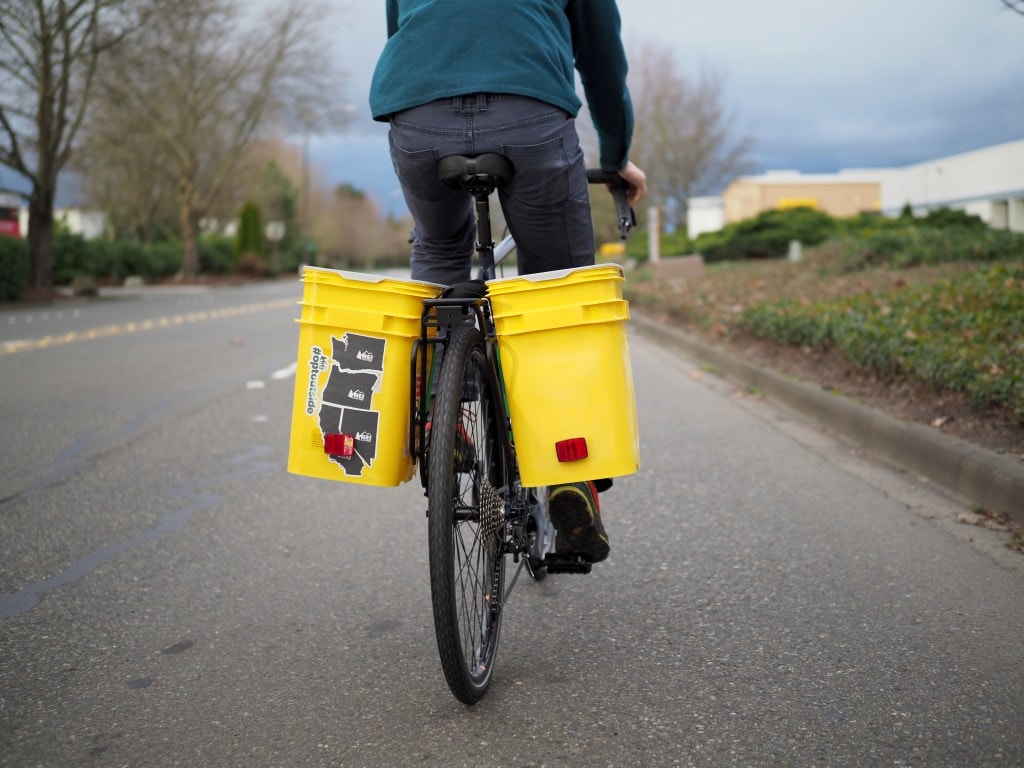
How cool would it be to roll up to the farmer's market (4.3 miles away) with these cool kitty litter panniers with instructions from REI?  


Wednesday, January 22, 2025

Temu air quality tracker

One of my open questions from Holman's book was, how much ventilation do we need?  Is there any data to support this 10+ minutes twice daily prescription?  Doing so adds a bit of extra complexity to life, what with climbing on the counters and getting out the mop handle to wedge the old timey upper window panes closed again.  It seems like only a matter of time before I crack an antique window pane with this protocol.  It would be nice to have data to justify it.  

Luckily DH had two cheap air quality meters from Temu.  He wanted them for safety when using the compressor in the garage to fill his own scuba cylinders and in his pre-sober days when he was distilling moonshine in the same lair.  To that end, he did a side by side reading with a higher end one at the professional scuba air fill shop and thinks they are bang on accurate enough to take seriously despite the bargain price point.  
When we initially set up his spare in the kitchen, it was throwing a lot of alarms, so let's get familiar with the acronyms and the general guidance on them... 

HCHO:  formaldehyde (good = less 0.125)
TVOC: Total Volatile Organic Compounds (good = less than 0.3-0.5)
PM2.5:  particulate matter 2.5 microns or less (good = less than 5-12)
PM10: " " 10 microns or less  (good = less 150)
CO: carbon monoxide (good = less than 9)
CO2: carbon dioxide (good = less than 1000)

I'm not sure what had been going down in the kitchen, but ours was very upset about formaldehyde, volatile compounds, and carbon dioxide and it was also giving our carbon monoxide and PM2.5 scores the side eye.  

I ran our HVAC fan for 15 minutes and knocked CO2 down to the 800's and then opened the windows for another 15 knocked it down to the low 400's which seems to be where it has stayed.  So yes, these air quality monitors are great to have on hand and if it throws some alarms, by all means ventilate and see if you can move those numbers in the right direction....  

But I had a theory that our status quo life would ramp the numbers back up to the danger zone again and that I could use that rate to calculate how often we need to ventilate.  It turns out that with general household activities and no ventilation, these numbers have stayed pretty stable ever since the 30 minutes after first plug in.    

I have spiked CO2 somewhat consistently when spraying down counters with undiluted vinegar... That seems to make sense because I can see a CO2 in its chemical formula (CH3COOH) which is about as sophisticated as my high school chemistry will support.  Maybe if I tried diluting my vinegar to 1:1 as some resources suggest would mean it doesn't spike quite so high?  Either way, I find the spike dissipates about as fast as it takes for the smell to dissipate, so I don't think it is a pervasive problem.    

Some other tests in the hopper-- impact of cooking pizza, candle burning, and renovations.   

Of the metrics that seem to have stable baselines, it looks like only the super fine particulate matter PM2.5 is a bit higher than guidance...  Checking how to reduce that, the internet suggests: 
  • ventilate (but PM2.5 did not seem to move with 30 mins of ventilation and outdoor PM10 figures are currently higher than our indoor PM10 reading)
  • reduce outdoor particle entry with doormats (done) and shoes off at door policy (half-observed)
  • clean home regularly (... work in progress for us all-- we currently have a robo vac doing a once over  of the main living space daily, but we also have 2 double coated dogs)
  • control humidity to suppress mold (currently 24% which is under the safe 30-60% EPA guidance and we live in an arid climate)
  • use low-emission cleaning products and air fresheners (vinegar and baking soda are our defaults...  I haven't lit a candle in over a week and do not habitually do so) 
  • maintain your hvac system (just serviced 5 days ago and uses a MERV 13 filter changed monthly)
... so I'm not seeing any smoking guns on ways we can further reduce PM2.5... I can try running our portable HEPA filter right in front of it to see if that has an effect?  15 minutes of high powered filtration in, that score has not budged though.  

edit:  

*  Running the pizza oven definitely requires ventilation!
*  Weekly habit of lysol spraying shoes and phone also triggers an alert.  Need to research more eco-friendly cleaning approaches for these (or skip) 

Sunday, January 19, 2025

Cleaning Up Book Notes: A Healthier Home: The Room-by-Room Guide to Make Any Space A Little Less Toxic(r)

I posted a review to goodreads, but wanted somewhere to capture my detailed notes that don't languish as a print out wedged in a notebook somewhere.  Holman organizes her book based on room, but I found it was easier to group these differently.  There were ideas I wasn't quite persuaded were worth the effort and required a bit more experimentation, ideas that were quick hits of low effort and addressed problems I already have I want to capture on a shareable pinterest board, wishlist items (but let them age to perfection before pulling the trigger), and ideas that I contemplated and decided didn't make sense.  

Experiments --> Habits:  

  • Check if DH has an air quality meter or procure one.  Test:  
    • Baseline indoor air quality
    • After opening windows/doors 10-20 mins-- how long 'til notable difference?  If there is a difference, how long until air quality returns to baseline after closing?  
    • When cooking (pizza, induction Mex Mondays, instant pot)
    • When burning a candle 
      • Revise habits around opening windows, cooking, candle burning accordingly 
  • Deep clean floor + white towel tests (save + compare towels)
    • White towel back entry immediately after deep clean (control)
    • Retest after various intervals:  1 day/1 week/1 month and compare towels, note confounds
    • Implement shoes off in house policy and repeat tests
      • Revise mopping frequency and shoe policy to reflect findings
  • Meal prep- try soaking and sprouting beans prior to cooking.  Did it have an effect on gas? 
  • Meal prep- do you still have a kill-a-watt?  How much energy (and time) do you need to heat a mason jar in the instant pot vs. the microwave?  
  • Laundry - try putting vinegar in the fabric softener compartment and evaluate whether there is a notable difference in clothing texture (or build up in machine)
  • Playtest buckwheat pillow again (and figure out what is in my favorite pillow)
  • Playtest rolling duvet up like a burrito to put cover back on
  • Playtest decanting super perishable produce (berries, 2lb bags) for easier consumption and to rogue out ones damaged in transport
  • Playtest D minder app 
  • Playtest a bottle of Ms. Stewart's bluing in the shower instead of a toning shampoo 
  • Playtest packing a to-go shower kit for Tue
  • Try growing arnica (perennial herb for pain/bruising but may only be hardy to zone 9)
  • Stow wifi headphones on the charger (vs wearing as accessory) when not actively using 
  • Recurring to do list additions
    • Daily declutter 
    • Mitey Monday do a dust
    • Thirsty Thursday- water plants
    • Thermostat Tues/Thurs (go upstairs and disable/reenable based on DH WFH usage)
    • Quarterly 1 gal vinegar to washing machine clarifier (discontinue if no appreciable difference)

Pinterest green living ideas board: 

  • Teeth:  floss first, nano-hydroxyapatite toothpaste (don't rinse!), brush your tongue if you like!  
  • Dryer balls with safety pins
  • Hang dry swim gear, hang dry pants (they just get creased and elastic gets shot faster in dryer)
  • Simmer pots on low humidity days instead of burning scented candles 
  • Ripe avocados go in the fridge to buy time
  • Separate onions and potatoes 
  • Dilute Dr Bronner's soap in the hand soap refills to 1 part soap 3 parts water (hopefully it will gum up less than undiluted) 

Planned Upgrades:

  • For product swaps, check ingredients on at least 2 to defend your purchase:  EWG, CIR, incidecoder .  
  • Saalt menstrual cup (wish I had hit my stride with this before the hiking trip!)
  • Silicone bottles to enforce post-swim lesson dichlorination shower and decant my almost empty products into a container I can completely empty.  
  • More weather-resistant plastic box for poolside first aid kit
  • Amber motion detecting night light for bathroom(s) should help with less overall light pollution at night, and less sleep disruption for DH in the morning.  I don't think this needs to be a salt light to have effect and and led may have a lower eco footprint than an incandescent.    
  • Berkey filter- still pretty happy with our city tap for the price but could see this being very useful in an emergency.  
  • Refill emptied hand sanitizers with rubbing alcohol, aloe, and an essential oil (get more Tea Tree, Frankincense, and Myrrh)

Will Not Implement:  

  • Think Dirty:  $40/year subscription with minimal technical info outside the pay wall (top 10 lists).  With my cabinet o' vinegar and baking soda, I am not buying enough novel products to justify this much of a research budget.
  • EWG as a one-stop resource:  I found several criticisms of their neutrality-- they push the agenda of the organic lobby (I usually do too, but good to know where the wind of incentives is blowing), requires companies pay to have their product certified (didn't the mafia offer protection services too?), uses fear-based tactics to mobilize product consumption (ick, my water has arsenic!  ooh, check out all these filtration options!), and posts consumer research questionnaires that are actually marketing lead generation tools (/unsubscribe).  Net, I'm inclined to believe the world is a better place for their efforts but think it is prudent to look for a second opinion on their suggestions and be more circumspect before designating them for charitable giving.  See additional options linked in the planned upgrades section.    
  • Charcoal teeth whitening: abrades your enamel! 
  • Veto'ing everything with petrochemical origins (author equates these to swathing oneself in plastic) - petrolatum is a world class occlusive agent if you need to lock moisture in.  
  • KO all the candles - I will probably eventually come around on this one...  but I have so many candle-making supplies and fun fragrances!  At least let me learn the candle making badge series first! I have an inkling they aren't great for indoor air quality based on how black the HVAC filter looks when I've been dialing up the hygge, but it would be great to quantify that more precisely.
  • Acid bathing all produce immediately after purchase (besides root veg).  This seems too extreme for the trace amounts of ick on predominantly organically grown produce.  
  • Buying additional microfiber cloths-- I have a bunch I am slowly wearing out, but too many resources have commented on how they shed microplastics and I have way too many discarded clothes I am "donating" that I should more realistically be using as rags.     
  • DIY ACV and baking soda hair treatments to offset/clarify soap alkalinity -- the pH rationale seemed suspicious here.  We are slightly alkaline (7.4) bar soap is more so (8-10) but vinegar is substantially acidic (2-3).  It seems like you could knock your microbiome more out of whack with vinegar in an effort to correct a slightly off pH balance soap.  I'm staying the course of generally trying to use less product-- skip shampooing's if I'm having good hair days, focus soap on the stinkiest/dirtiest bits of anatomy.  
  • Store citrus and apples in the fridge-- it may extend shelf life (and in the case of apples, delay ripening of other items in the fruit bowl) but I find it way harder to remember to eat things hidden away in the fridge so to have a rip van winkle apple in there is a pyrrhic victory.  
  • Turning off wifi in evenings -- maybe an aspiration if ever there is a Widow Belle.  DH goes to bed after me and relies heavily on screens to wind down (I know!) or finish office work.  We are also a week past installing newer faster wifi because we are concerned about all the smart lights, thermostats, cameras, etc. that might break in the process.  The faces of addiction!  
  • HOCL machine-- this was described as a lower tox alternative to bleach using only salt and vinegar but further googling leads me to conclude is basically diy bleach maker pre-dilution.
  • Applying diatomaceous earth with a turkey baster-- man, that stuff was messy!  So I will file that baster trick away as a good tip, but we are not actively trying to defend a perimeter from ants with DE and if we were, I'm pretty sure it would only last until the next robo vacuum sweep.    

Tuesday, January 7, 2025

Frank R. Bowerman Landfill


Yesterday, a classmate's dad hosted us at his work, the Frank R. Bowerman Landfill (11.6 miles).  This one isn't historic, per se, as it was established in 1990, but it is an integral part of our daily lives.  "We only close 5 days per year and stayed open as an essential service all during Covid,"  remarked Isaac.     

DH was jealous he couldn't get a peek behind the curtain because this landfill takes commercial waste haulers only.  His latest landscaping debris had to be driven all the way down to Prima Deshecha in SJC (27.2 miles).  A busy day for DH was two trips, the commercial haulers try to make 4, sometimes 5 drops at the FRB in a day.  These are massive semi trucks that dwarf the still substantial trucks that patrol residential areas.  These trucks deposit 11,500 tons of waste per day, netting FRB just short of a half million dollars per day in revenue.          

I was particularly interested in this excursion because I am starting the Cleaning Up badge sequence and, having lived in Irvine, I appreciate how particular the Irvine Ranch developers are about NIMBI considerations.  "We get about 5 complaints per year from the 'super smellers' who are in the new housing development on the other side of the toll road.  Always in winter, when there are temperature inversions, the days you may get "no burn" alerts because a warm layer of air is being pressed close to the ground and making everything smoggy."  This called to mind the introduction of The Lost Art of Reading Nature's Signs and Gooley's observations that during temperature inversions, you can hear train and traffic noise more loudly and even pick up on radio transmissions outside of your normal range (like behind the iron curtain during the Cold War).  

Isaac went on to elaborate the numerous mitigations in place to keep the complaints to a minimum.  There are hurricane fences with screens that match the landscape built to the perfect height to mask the volume of truck traffic along the roads.  These also catch fly away waste and have mister heads to suppress dust.  Every night, the exposed cells are covered with $30,000 of tarping to deter coyotes, birds, and smells.  The 22 megwatts of methane is sequestered "to power Disneyland" in Anaheim (or 14,700 average sized homes) or burned in flares when permitted.  The land run off is routed to basins and tested before any is released into the water table while leachate from landfill cells is collected in tanks for hazmat disposal.  "Usually this time of year, these basins are full," Isaac remarks wistfully as we drive by an empty cement divot and we say a silent prayer for rain.  Green waste is heaped in windrows to cook as compost for a quarter before being sifted and offered back to the public and public works projects at low or no cost.  "Most composting facilities operate on dirt, but we put ours on an asphalt pad on a 2% grade so we don't have pooling and smells, we pump the run off back up to these towers for fire mitigation and to continue to irrigate and turn the piles to keep them at 150 degrees."  They even have a biologist on site who has created a segment of the land that is kept native and introduced a wetland to protect wildlife.  This biologist also works with a paleontologist to determine if there are archeological finds that need protecting as multi-million dollar earth movers carve new cells into the canyon side and cover over the filled cells.  The lobby of the visitor center has a trophy case filled with mammoth and prehistoric river dolphin tusks and bones alongside Lunch at the Landfill and Dinner at the Dump gala invitations and numerous awards.     

Thinking about the sink holes I had read about along the California coast which had been drilled heavily for oil, I asked about subsidence and he nodded to a newly repaved section of the road we had just driven over.  "We get that.  Some older landfills have enough settlement that even though they are at the max altitude allowed, they can still stay open because of some settlement."  

"I come almost every week day, unless the waves are good..." quipped a deeply tanned Darryl, with Windy, a Harris Hawk perched on his glove.  "The crows almost know which days are the weekends."  Windy acts as a deterrent for birds which would come to pick over the trash, making it hard for dump trucks and machinery to see and operate and leaving droppings on the new housing developments full of super sniffers on the other side of the toll road.  "Harris hawks are like the Labradors of the raptor family, easy to train, hard to spook.  If she goes missing, she has telemetry on her ankle band and I follow it and put out her favorite toy to recapture her.  My Red Tail at home would never tolerate this..." he grins as my 6 year old reaches up to touch a feathered chest.  


Isaac also mentioned challenges on the horizon, even for a well-managed dump.  The leachate collected from the cells is removed by a hazmat company, which is better than older dumps which do not have liners to capture leachate infiltrating their water table, but I wondered how this company went about neutralizing the liquid.  He itemized materials that were pulled out for recycling like mattresses and household appliances and I wondered about how responsibly refrigerants were removed with the awkward handling of the forklifts.  He talked about cameras on trash pick up trucks that could detect, notify, and eventually penalize residents for improperly sorting their trash.  He noted that China no longer takes our poorly sorted recycling and that solutions have had to be cobbled together domestically, but it is hard to get them approved in California.  We discussed waste haulers who were understaffed and made the decision to combine pre-sorted residential green and household waste dumpsters to be able to complete their pick up routes.  "They aren't supposed to do that, but the directive is to divert 50% of green waste now, increasing to 70% in future years, so some make the decision to do it..."  But he notes that when the canyons are full, we might face $100 trash disposal bills like those of NorCal.  "We would have to rail-haul it inland to another state and that isn't cheap."  Current projections have this 725 acre canyon on track to close in 28 years.