Thursday, March 19, 2026

Origami


 Research the history of origami. Practice a few folds, then jump in. Start by making a simple design like a crane, plane, or boat.

Ironically, the best history of origami I came across was a digital resource public paper-folding history project.  

It arose independently in 3 regions (Europe, Japan, and China).  The traditions began to influence each other between 1867 and 1904 with increased globalization.  The site posits that the development of kindergarten and its paper craft curriculum starting in the 1850's established mass-appeal for paper folding crafts.  

I learned that a simple bird shape was called a cocotte/pajarito.  They were sometimes interpreted as horses.  Cocotte could also be used figuratively as a term of endearment directed toward a child, to imply something was childish, or a higher-class prostitute.  Incidentally, I got the impression that of the European countries, Spain had the strongest legacy of paper folding, with Miguel de Unamuno receiving acclaim for his pajaritos.  This could be from Moorish influence, yet there is no section of the website which covers Muslim or paper folding in the Middle East.  

There also seems to be some debate on if cutting is permissible (or shunted off into a separate discipline of kirigami).  Personally, I am more impressed that such an abundance of shapes could spring from a single material and could be unfolded back to their original shape without corners getting cut.  However, I am also intrigued by the indigenous American tradition of papel picado, or pierced paper which involves more cutting than folding.    

Here is my list of cool things to make a contemporary version of: 

  • Mitres of infamy (1394): Public humiliation hat which listed the wearer's offenses.  In my case, I would make them as "name tags" at big parties and maybe they'd get more use if I called them paper crowns!  
  • Dollar bill folds in rings, bow-ties or other ornate shapes for cash gifts
  • Grocer's cones and other beautiful biodegradable boxes to share food on the go, bonbons, or around the pool.
  • Pastry boxes as a substitute for seed-starting flats
  • Paper boats to race across water ways or airplanes to race across driveways
  • Containers to trap bugs
  • Napkin/toilet paper ornamental folding 
  • Collapsible lanterns for mood lighting
  • An ark of animals 
  • A bouquet of flowers

Likewise, while I checked several origami books out of the kid's section of the library, I had trouble following the instructions.  Ultimately, I found previewing and then watching Jo Nakashima's youtube tutorials in slow motion with frequent pauses was the most effective way to end up with a recognizable end product.  I "jumped in" with a frog and some extra sticker eyeballs.  

Monday, March 16, 2026

Civics Challenge


My kid just wrapped up the Revolutionary War unit and we have just embarked on an unconstitutional war in Iran, so this seemed like as good a time as any to brush up on civics.  


Beginner Level 

Research and learn the answers to the following questions: 

• What is the supreme law of the land? The Constitution of the United States of America

• What does the Constitution do? It is the foundation for the federal government and protects individual rights.  

• The idea of self-government is in the first three words of the Constitution. 

What are they? We the People

• What do we call the first 10 amendments to the Constitution?  The Bill of Rights

• Name two rights or two freedoms listed in the First Amendment (five are 

possible). Religion, speech, press, assembly, and petition.  

• What did the Declaration of Independence do? Formally severed the 13 American colonies' ties with Great Britain, announcing their separation to the world.  

• Name two rights in the Declaration of Independence (three are possible). Life, liberty, and pursuit of happiness.

• What is freedom of religion? The ability to to believe, worship, and practice their faith without government coercion or discrimination.  

• What is the economic system in the United States? Mixed economy.  Capitalist private ownership with government intervention to regulate and provide public services.  

• What is the “rule of law”? All people, institutions, and government entities are accountable to publicly promulgated, equally enforced, and independently adjudicated laws.  No one is above the law.  


Intermediate Level 

Research and learn the answers to the following questions: 

• Name the three branches of government. Legislative, executive, and judicial.  

• What keeps one branch of government from becoming too powerful? A system of checks and balances established by the constitution.  

• Who is in charge of the executive branch? The president.  

• Who makes the federal laws? Congress.

• What are the two parts of the U.S. Congress?  House of Representatives and Senate.  

• How many U.S. Senators are there? 100 

• Name one of your state’s U.S. Senators and one of your state’s U.S. 

Representatives.  Alex Padilla and Adam Schiff are California's Senators.  We have 52 seats in the House of Representatives and Congressman Lou Correa represents our district 46.  

• What is the term of a U.S. Senator? 6 year terms that are staggered with no term limits.  

• What is the term of a U.S. Representative?  2 year terms with no term limits.   

• What is the term of the President? 4 year terms with a 2-term limit (22nd amendment).  

• Who is the Commander in Chief of the military?  The President, but only Congress can declare war.

• Who signs bills to become laws? The President.  


Expert Level 

Research and learn the answers to the following questions: 

• Who vetoes bills? The President can veto bills.  Congress can over-ride the veto with a 2/3 vote in both chambers.  

• What does the judicial branch do? Interprets laws, applies them to specific cases, and determines if laws or executive actions violate the U.S. Constitution

• What is the highest court in the United States? The Supreme Court

• How many justices are on the Supreme Court? Nine.  

• Who is the Chief Justice of the United States now? John Glover Roberts, Jr.  

• Under our Constitution, some powers belong solely to the federal government. 

Name two (four are possible). Declaring war, printing money, regulating interstate trade, and making treaties.  

• Under our Constitution, some powers belong solely to the states. Name two 

(five are possible). Education system, intrastate commerce, police powers of safety/health/welfare, conducting elections, and establishing local governments.  

• Who is the Governor of your state now? Gavin Newsom

• What is the capital of your state? Sacramento

• What are the two major political parties in the United States? Democrats and Republicans

• What is the name of the Speaker of the House of Representatives now?  Mike Johnson


Extra Credit:  

What are the US Territories?  Puerto Rico, Guam, US Virgin Islands, American Samoa, and Northern Mariana Islands.  Their members are US citizens but lack voting representation.  

How come Arizona has no DST but California is still springing forward years after voting to end it?  Uniform Time Act of 1966 allows states to opt out of daylight saving time.  This is what Arizona did because the extreme heat would make jobs less safe under DST hours.  Hawaii has a similar arrangement.  California Proposition 7 passed in 2018 giving California legislature the ability to drop out of observing DST.  From there, CA Senate bill 51 was proposed to put California on standard time year round, but it stalled in committee.  

What is an executive order?  A directive issued by the President to federal agencies which has the force of law but does not need Congressional approval.  They can be challenged in court if they exceed constitutional or statutory authority.  They can't contradict existing legislation, spend money not appropriated by Congress, or create new taxes.  They can be revoked or modified by subsequent presidents.  Previous examples of executive orders have been the suspension of habeas corpus (protection against indefinite imprisonment without trial) to address secessionist activities during the civil war and to quell activities of the Ku Klux Klan and creation of internment camps during world war 2.  

Friday, March 6, 2026

Lost Art of Letter Writing


As part of an initiative to get better at relaxing, I followed a whim to purchase a "pocket scavenger hunt" journal at my daughter's Buck a Book sale.  The first item: postage stamps.  

Well, I had plenty of those in a disorganized pile from what has turned out to be four years of correspondence with penpals in Virginia and Poland.  Added to the chaos was all the wonderful sister mail that has accumulated from being a part of the Wildflower henhouse on MaryJane's Farm.  Well.  Maybe this is a nudge toward getting my letter-writing station in order?  


Major enhancements: 

  • Rogued out the envelopes for more compact storage (snipped the postage stamps and a "good" version of each sender's return address).  Envelopes were shredded for compost.  
  • Grouped correspondence by sender.  Labeled with a post-it note with the return address stapled to it.  Substantial correspondence warranted a binder clip, otherwise a paperclip, or nestle greeting cards into each other as a make-shift folder.  Try to to arrange chronologically.  Remind self to date future outbound correspondence for easy organization.  
  • Graduated the penpal folder and MJ Farm folder to accordion expansion-style folders to hold the excess
  • Gathered pens, postage, envelopes, address stamper and miscellaneous stationery in a single drawer.  Decided to add checkbook as well because much of my correspondence has been bill pay.  
  • Dust letter-writing station to make it more inviting.  Admire work and memorialize with a photo.  


Areas I am still noodling on: 
  • Address book in theory and practice.  In a perfect world, I would capture everyone's birthdays, anniversaries, etc. along with a summary of our past correspondence and contact info in one single organized space.  Should it be a physical book?  Something saved digitally?  What fields should I capture?  I find the most frequent use cases for an address book are (1) sending postcards when far away from the letter writing station - so I print out a physical list of addresses to take with me and (2) replying to a received letter - so having their address on a post-it as I file when I received seems like the most streamlined workflow for now.  Sure, I will miss birthdays and not have a consolidated list for Christmas cards, but let's crawl before we run.  
  • Thank you notes.  This stationery probably needs its own dedicated drawer, especially if I tackle the gratitude challenge in MaryJane's Farm.   
  • Flourishes.  I noticed in leafing through old letters I love the flourish of a wax seal or a lacy paper punch.  Maybe a few of these could be justified "upgrades" to my station.  How cool would it be if my wax candles for ambiance doubled for sealing envelopes?   

Friday, February 27, 2026

Path to Zero Waste

 Research zero-waste living.  

Original resource link was broken, so I read A Year of No Garbage.   

Find out what a waste audit is and why you should perform one to start your path to zero waste.  (discard studies link)

1.  Find the edges of your study. Choose a timeframe and a location for your audit

I set out to measure all the recycling and trash I collected during a one month period (Jan 2026). 

Out of scope:  

Itemizing types of recyclables-- I went by gross weight, but if doing this exercise again, it would be constructive to audit just my recycling and trash with a category for "trash plastic-films,"  "recyclable plastic," and "other" (aka glass, aluminum).  

Compost.  We already compost and shred our junk mail into a vermicompost.  I worried that weighing it would discourage me from continuing the habit.  

Blech unhygienic items:  flushed or not washable to go in the gather pile.  Containers which could be rinsed were in scope, but things like the odd wet wipe (though I primarily pre-game with a bidet) in the bathroom trash, or used strings of activated charcoal dental floss (in a sustainably grown bamboo container) went out without itemization.  Schaub had a similar rule in play in her Year of No Garbage book.  

Items accumulated In Transit.  I tried to limit eating out and pack back home the wrappers of the occasional excursion, but it would have been infeasible to do this on an international trip or in some circumstances.  In those cases, I commented and reflected in the daily log on items I had not captured.  For the days we were on holiday, I tacked on extra days into February to amount to a full month.  

Husband purchases.  These are difficult to have much influence on while maintaining domestic tranquility.  We have different levels of commitment to reducing waste, so I would do what I could to restock items he uses to pre-empt a purchase and sort items he had categorized as trash (or items he felt were recyclable that my research indicated would contaminate the process) where it was easy to do so tactfully, but I generally left his business alone.   

Semi-in-scope?  

Kid items I was complicit in purchasing.  Initially, I planned to focus just on my personal waste stream, but over the course of the month, my conscience nagged at me.  I found I was increasingly counting convenience food items I purchased and prepared for her in my waste stream, but did not do this consistently throughout the month.  

2.  Collect that waste! 

My trash audit was logged on this blog post

3.  Categorize and count your waste. 

13.2 lbs recycling, 4.3 lbs trash photographed and weighed for the month.  For the full log see this post.  

How is your waste different from your city’s waste stream (see their annual reports)? Why?

This was surprisingly low, with the trash gathered in a month amounting to slightly less than what some sources say the average American produces in a day (4.9 lbs).  With 3x more recycling than trash by weight, it seems like we are already making some more sustainable choices.  Even so, I'm a little discouraged that I generate almost twice my body weight in trash and recycling per year even while on my best behavior during an audit.  

I think our waste was different because we already compost, shred junk mail, and have tackled the "low hanging fruit" for decreasing waste over the last few years, like working with a donation pickup service and ewaste recycler.  I also knew we were doing a trash audit, which changed my behavior-- I wasn't as likely to embark in a big decluttering session if I had to weigh everything I pitched.  

What is the largest category of what you throw away?

The most common/galling categories of trash were (1) plastic food packaging, even for whole unprocessed foods and (2) packaging from mail-order purchases.   

How much of your waste is preventable, and how much is not? Can you actually prevent the preventable portion of your waste? How?

Food packaging-- we already prevent a lot of it by limiting eating out and bringing a cup for coffee shop stops.  I try to select bulk sizes and paper wrapping options where available (i.e. flour) because these can be shredded and generate less packaging per unit.  To go a step further, I would keep a separate shopping list for produce and bulk goods I could buy loose and scoop into my own reusable bags rather than combining these with a single drive up delivery order.  I have tried purchasing these at a local farmer's market and come away with less packaging, but find the prices are generally higher than what is available at the grocery in the organic section so save these excursions more for intelligence-gathering about what is in season locally and one or two really good deals.    

Mail order packaging-- this is the hardest to control.  I already do what I can to purchase common products at the grocery/local store rather than ordering them online.  When ordering online with Amazon, I select the "eco" slower shipping that promises to combine orders.  I try to save my online shopping for a single day of the week to further consolidate my purchases and the packaging they require.  Most durable items I try to buy used/refurbished and think I am mostly shopping to replace completely worn out items rather than seasonal decor and fast fashion experiments.  To go further would be to spend more time working on anti-consumption goals, like participating in a Buy Nothing Group.  I could also write letters to online shippers requesting non-plastic packaging.  

How much of your waste could be diverted from the trash to other destinations, like recycling, composting, or reuse? Would the biggest category in your audit be impacted by diversion?

We already do a lot of composting and recycling.  We usually use up our consumables and wear out the durables.  There were a few items we donated (i.e. pants with rips) that I could have gotten handier at patching, but told myself "if it is ripping here, it will rip elsewhere soon."  It seems like to cut waste further, we would need to cut back hard on purchases and focus on "making do."  

How is your waste specific to your local place and culture?

We are in a parenting hustle season, so some of the areas we continue to be trashy are because doing so is logistically convenient or expected in group gifting/potluck/school lunch settings.  We don't want to have to explain ourselves, deplete limited time or energy, or have our kid feeling like a weirdo.  

Where in your building, town, campus, etc, is the most trash created? Why? Can that be changed?

Most of our trash goes into our kitchen waste bin since this is where we spend most of our time and meal prep generates the most trash.  The bathrooms throw a tiny amount of waste (i.e. dental floss, non-flushable wipes).  

I keep our hamper for donations in the closet because it is close to our "not playing with" parking lot (under the bed), worn  out/seldom used items in the closet, and it is out of view of our kid who would otherwise rifle through it.  


Think of small, yet meaningful, ways you can reduce your waste and implement them into your daily routine. For example, instead of throwing away kitchen scraps, re-grow veggies, and think of ways to reuse or repurpose things that would otherwise be disposed of. [Expert]

Here is a list of 30 things I could do to reduce waste based on this audit.  I will strike out the ones I have already implemented.  

1.  Schedule a reminder every January to do another trash audit.  Next time I will measure the plastic materials specifically.  

2.  Do a no/low-spend challenge to reduce the amount of mailed packaging.  

3.  Add farmer's market to the family calendar on the fortnightly day when the salsa vendor and the honey vendor are there.  

4.  Go to the farmer's market!  Bring reusable produce bags and a price list for what the grocery cost for seasonal produce would cost for comparison.  

5.  Craft more produce bags so you don't run out on a shop.

6.  Split some grocery drive up orders when scheduling allows.  Personally shop the produce/bulk list with reusable bags when you come for drive up.  

7.  Start a list of home-growable produce, to further reduce plastic packaging.  Bring with when visiting the nursery.    

8.  Trial large bulk order (i.e. Azure Standard) for dry good staples (flour, rice, beans, etc.)  Keep track of date product started to better predict how much and how often to restock. 

9.  Continue to experiment with lower waste make from scratch convenience food copycat recipes (mashed potatoes, acai mochi)

10.  Schedule online shopping for a single day per week [Mercado Miercoles].  If you order something on a different day, keep a journal of what it was and why.  

11.  Write a letter to your favorite online seller requesting that they offer an option for non-plastic/low packaging shipment that you can opt into.  

12.  Review shipments when they arrive with a specific comment on the quantity and plasticity of the packaging.   

13.  Stash a box cutter close to the recycle bin  to encourage breaking boxes down for proper recycling

14.  Keep a spending journal for a day/week/month with reflection questions (i.e. need vs want, borrow/buy used options researched)

15.  Post an item endorsement on BIFL (buy it for life) reddit 

16.  Post something constructive on Anticonsumption reddit

17.  "Re sort" an item the family mis-categorized into the appropriate trash/recycling/compost category

18.  Experiment with a countertop compost cooker to see if this improves breakdown of tougher items (eggshells, avocados, pits)

19.  Line dry a load of laundry to reduce dryer lint

20.  Schedule a washcloth/reusable rag purchase with every empty paper towel roll collected

21.  Donate a diva cup, bottle bidet and other new period gear to a shelter "staples" drive to decrease amount of disposable sanitary trash

22.  Ask preschool if they would like a wormbin and help to set it up

23.  Work on the homespun Christmas badge and find ways to whip up gifts/hostess consumables that are low/no packaging (i.e. mason jars, pyrex jars, reusable advent calendars, bath bombs, massage bars, etc.)

24.  Complete Goodwill service patch with daughter to recruit another helper in our 6 times/year pickup please donation contribution. 

25.  Buy a set of reusable ziplock bags for every empty box of disposable film we empty

26.  Invite friends to a picnic instead of meeting at a restaurant

27.  Request to be removed from a catalog mailer I do not browse.  Use a box cutter to remove the spine and shred the remainder.  

30.  Visit Northgate to investigate lower-packaging for Mexican staples (dried chilis, beans)

31.  Get a set of reusable plates/utensils/cups for the scout troop to reduce waste at meetings

32.  Buy "sticky" condiments (i.e. PB, nutella) in a glass bottle that is easier to clean than the plastic if making from scratch is too tough

33.  Post a request or an offer on a buy nothing/craigslist group

34.  Buy 2 copies of No Garbage book and sock one away in a free lending library

35.  Save "compostable" baggies from produce and find a way to install mini-trashcans they could line in the bathrooms now that we have worked through our plastic film bag liner stash

36.  Invest in cloth napkins and figure out how to fold them into cute lunch box critters.  

Wednesday, February 18, 2026

Geography 201

 Penpals aren’t just for kids. Take advantage of social networking and try to make at least one new relationship in the world that is not geographically close to you. 

In January of 2022, I had the pleasure of being connected to a penpal in Poland through a Youtube channel we both followed (Daily Connoisseur).  While it typically takes about a month for letters to be delivered, it has been so fun to compare notes and see how her life has unfolded.  Now that we are back from Spain, we can send my brother and sister in law letters too, although letter writing is a bit of a lost art, so we don't expect the dynamic to be as equal of an exchange.  


Plan an overseas vacation (don’t worry, you don’t have to actually go to earn your badge). Map out where you’d stay, what you’d like to see, how you’d get there. Research options like hostels, camping options, monasteries, Airbnbs, home swaps, etc.

Itinerary:  Barcelona, Spain, Jan 28, 2026-Feb 7, 2026

Objectives:  see brother + sister in law's house in Sitges suburb, celebrate FIL 80th bday (and other BIL's bday) in big masia farmhouse rental, then spend 4 days exploring downtown Barcelona.  

Lodging:  

Masia in Santa Oliva Jan 29-Feb 2.  Share of cost TBD.  Objectives-- adjust to jetlag, see BIL's house, celebrate FIL's 80th birthday.  Try spring onions (Calçotades) and jamon.  FIL picked this location and it is his big day.  The logistical challenges it presents are that it is 1 hour by car or train from downtown Barcelona which makes exploration with 7 year old attention and energy ebbs and flows less accessible.  It also sounds like quite a few celebrants from FIL's second wife's family will be in attendance so even if the space is large, it may not offer much solitude.    

Casa Gracia hostel in Eixample Feb 2- Feb 7.  $1,143 Euro. Objectives -- explore the city.  We chose this location because it is close to metro hubs and within walking distance of modernist architecture we would like to see (Casa Batlló and the block of discord).  It also has the advantage of being on the grided part of the city which is more straight-forward to navigate and BIL claims it will have slightly less noisy nightlife than other parts of downtown.  We don't typically consider hostels as a family but were finding that when we said our party was 3, many options required us to reserve 2 separate rooms.  The hostel included private rooms with up to 6 beds and a private bath.  Because they don't claim 5 star status, this proved to be pretty affordable.   

Transportation:  Flights arranged through Delta with a connection in NYC.  Jens has secured an international driver's license from AAA which we will use while staying at the Masia.  We plan to walk/uber/experiment with mass transit while in downtown Barcelona.  

Preparation:  

Flights settled by Chris

Barcelona lodging booked by Chris

AAA international driver's license and rental car reservation secured by Jens

Phone service and data plans updated to international by Jens

House/pet sitting secured by Chris

Euro cash ordered by Jens

Barcelona history/research by Chris (favorites)

  • Barcelona (Robert Hughes) - Extensive history of the region and culture up to the 1992 Olympic Games hosting 
  • Mission Barcelona: A Scavenger Hunt Adventure - worth packing as to gamify the sightseeing for Fallon.  

How it actually went:  

1/28:  Uber driver "Ulises" picked us up.  This seemed an auspicious way to start.  He cost only slightly more than 1 day of parking at LAX, so uber to airports is clearly the way to go.  I discover Starbucks has protein shot lattes (they aren't delicious, but drinkable).  A lady in the Starbucks line quips "I know you're not going to New York!"  "...  I am, but just the airport"  "Those sandals!  It is freezing out."  For the rest of the trip I am cognizant that I am the only person around wearing sandals, even in the land of espadrilles (none spotted).  But will still stick with these being a great "travel light" all purpose footwear option.  I also bought copies of 3 news magazines to see if any were clearly preferable and warranted an ongoing subscription.  Concluded New Yorker had the most interesting articles, but too much irrelevant "about the town" coverage for someone on the other coast, the Atlantic is still in stages of grief about the Trump administration, and the Economist still has a bit too much faith in the superiority of free markets...  Yet they don't use bylines, which seems a bit orthogonal to the objectives of the free agents in their employ.  I found myself wishing I had instead packed the Quaker magazines that I have been inundated with since sending them an honorarium.  


1/29:  Very jet lagged and we discovered in the 2.5 hour customs line that we have left Fallon's hoodie on the plane.  Feeling very grateful I packed the snow jacket which seemed like overkill because she will live on it for the rest of the trip.  We play a lot of "what time is it, Ms. Fox?" and I realize we need to expand our repertoire of games that can be played while in the confines of slowly moving lines (minimal gross motor, minimal noise, minimal fussy pieces to spill every time we inch forward).  The line does give us time to straighten out our phone plan to provide service in Spain.  My phone takes about an hour to switch over (making for a very dodgy exit from the auto rental with only a saved map to brother in law's house).  Jens's takes even longer-- maybe a couple days?  We deliver the case + of scout cookies and extra large box of cheez-its.  In later exploration of downtown bodegas, we see Cheez-its, they are available in Spain!  But no matter, we now have ample suitcase space for books and chocolate souvenirs.  We see some of brother in law's house-- mostly his sitting room-- because we are all sorts of jet lagged.  His dog is warier around rambunctious, squeaky kids than we had hoped.  We make it to the masia.  Fallon and I are the only ones that can stand upright in the low-ceilinged kitchen/galley.  But it is an impressive compound.  We think it was built in 1200ish and that it used to house visiting royalty.  We are mostly grateful for wifi with the sketchiness of our phones.  We try to find a late lunch but nothing in the town is open except a minimart.  Fallon chooses spaghetti and canned peas.  Excellent.    

1/30:  Sleeping is hard.  I discover a wealth of library books available for download on kindle and my backlog.  Work through most of 150 Strong.  Wake at 11:30.  Whole group goes to a beach town for late lunch (Casinet in San Salvador).  Grand-Dude and I go halfsies on a blessed paella which comes with a bottomless carafe of holy water (sangria?) I share with the table.  Moving on to kindle reading Milk + Honey poetry during the insomnia phase.  

1/31: Another lazy jetlag day at the masia.  I am thrilled to experiment with a real bidet.  Someone does a grocery run and I have a cold cuts flight.  It seems like it is all jamon and OK, but not worth jumping 9 time zones for.  Jens teaches me how to open email links in browser so that I can approve a girl scout cookie order, life changing!  Mostly he and Fallon are hanging out with unlimited screen time playing video games... Not exactly the ideal situation for skipping school.  

2/1:  Grand Dude's 80th birthday.  I finish Tribes Homecoming and start Henrietta Lacks.  I take a crack at running a load of laundry with some machine operating help from chatGPT and line drying it.  Jens is in charge of charring leeks for a calcotada sampler.  The grill vents right up to the second story balcony where the laundry lines are and everything smells like BBQ for the rest of the trip, but it could be worse.  The steaks he grilled were so good.  


2/2: Yes!  on the road again, seeing stuff, screening less.  The less than cordial dynamic with Fallon's fur cousin took some of the edge off being the first part of the contingent to decamp from the masia.   We stop at a little theme park, Catalunya in Miniature and get a preview of a lot of the architectural landmarks we will see next.  Fallon likes to push the buttons and get the trains to run.  I was impressed one button even starts a flare up that fire fighters rush in and douse with little water pistols.  We're able to return the rental car in the parking structure immediately under our Hostel which is great because driving in Barcelona is stressful.  They do have wide side lane affordances for buses, taxis, and bikers that I admire though.  I also like that they chop the corner edges off busier blocks which leaves more space for cars to turn and pedestrians feel less exposed.  Our hostel has 6 bunk beds!  Not exactly what I pictured based on the website, but Fallon and I love our top bunks.  We have dinner at Oassis, a restaurant right next door.  


2/3:  We breakfast at Boldu which is like a Dunkin Donuts but their guys are shaped like little men and so packed with thick cream.  I admire the hexagonal pavers on Gracia which were designed by Gaudi to go in Casa Batllo, but with production delays ended up in Casa Mila and along the walkway (also that Barcelona gives pedestrians such wide sidewalks).  Mema has heard you can buy a few souvenir pavers if you beg construction crews who are working on the street with a couple Euros.  Did not attempt this, but the Gracia design is very cool.  We pass Pedrera and admire its exterior.  We do the tour of Casa Batllo which was really well-done.  I loved that the audio tour was keyed toward waypoints within the house.  I also loved the study which felt like being inside a kintsugi broken pot repaired with gold at the seams.  I also loved the gill-shaped vents opening into a central courtyard to manage the temperature in different parts of the house.  Then we hopped a cab cross-town to meet up with the masia crew who were in Sagrada Familia.  We made good time, so Fallon pit-stopped at a McDonald's and was delighted to find they also offered packaged pineapple with the happy meals.  Sagrada Familia was also pretty impressive-- how they had used bluer tones in the stained glass on the northern side while awesome reds and oranges streamed in through the south side windows.  Fallon liked the "sudoku" grids of numbers that added to 33 no matter which row or column you added and we bought her a souvenir necklace of it.  When we had enough, we walked back toward our hostel and stopped at a chinese place with an "empanandilla" special which turned out to be dumplings.  Yum.  Barcelona doesn't really have kids menus or the typical picky eater standards (chicken nuggets/tenders, mac n cheese, pizza).  We did a lot of contingent ordering and plate swapping when it turned out what she ordered wasn't what she expected but she liked something from our entrees.  That happened in the evening when what we thought would be an approximation of fettuccini alfredo came redolent in the truffle oil we asked them not to use.  Turns out she likes spinach ravioli.  In the downtime between church and dinner, I hiked over to Amatller chocolate which was listed as a supplier on the fancy Utah-based chocolate mail order supplier I have been shopping.  I got a bunch of promising stuff to keep my cacao nightcap going-- hazelnut truffles, cava truffles, leaves of 4 different types, and a couple bars of single origin to compare to my other Ecuadors and to each other.  I also managed to ask for and purchase 2 umbrellas from a news seller on the Gracia sidewalk, which came in handy later, in this drizzly season.    


2/4: We trekked to La Nena for churros and chocolate and a packed in game of travel checkers.  We had initially set our heading for an acai place, but were disappointed it was closed.  Nena was a bit over-rated on variety and quality of churros and Fallon didn't like the churro at all, but I loved that they had play kitchen gear and board games.  I guess it makes sense (nena = grandma).  Plus the service was friendlier than reviewers led me to expect.  Since we were in Barcelona in off-season, it seemed just less of a maddening crush.  No long waits for restaurants, or tours of landmarks.  I'm not sure I could tolerate the city with tourist season in full swing.  There was a churroria down the street from our hostel that had a line wrapping around the block even in the offseason, so for a foodie, that was probably the ticket for really good churros.  Maybe next time.  After fueling up at Granny's, we continued on to the "Hibernian" (Irishman) not to be confused with the "Iberian" (Spanishman).  They specialized in used books, a favorite souvenir of mine.  I found one on Gulf of Mexico sunken treasure for Jens, 2 truly ancient ones (Kipling and Trollope) for me, and Fallon wanted Tim Ferriss's 4 Hour Work Week and a book about puppies.  We found an open and friendly acai stop (Tizana) on the way back to fill any gaps the rejected churro left in her stomach.  I finished Pollan's Food Rules during siesta time and we had underwhelming dinner at the hostel's restaurant.  The decisive point was when they asked if we wanted cheese on our nachos, and we, imagining processed cheese was something Europeans would reject at the border, were dismayed to see the nachos come back smothered in it and tasting like something terrible you would buy at a stadium.  


2/5: We stopped in Forno coffee shop/ patisserie behind Casa Batllo for breakfast and visited the White Rabbit museum that shared a block with Casa Batllo.  Fallon was attracted to it because of the oversized Caganer (pooper) statue at its entrance.  This was a fun stop.  We got to see VR videos of castellers building multi-story human towers and Saint Jordi defeating the dragon, posed in giant paper machie cappagrossos heads, and saw eggs balanced perfectly on fountain jets.  We continued on our quest to see Las Ramblas.  This was a bit of a hike for a 7 year old, so it required a break at a Lego store and then a chance to play in a massive square filled with pigeons.  One landed on my shoulder.  The rambla itself was a big disappointment-- completely ripped up on both sides for renovation with lots of construction noise and no statuesque buskers.  I did manage to pick up some calcots leek seeds to see how they'll grow in our own Mediterranean climate.  The Boquerria market was as amazing as the guides described, but Jens felt there was no fish there that would have tempted him.  We stopped in the Maritime Museum off Columbus Plaza to use the restroom, but didn't tour it.  We had spotted the cable car that cruised over the port to Mount Juic and wanted to ride it.  We took such a circuitous route to get to it though that we needed to stop and fortify ourselves with some mall food.  When we had ridden the cable car out and back, we caught a cab back to our hostel and saw bits of the old city through its windows.  We had dinner at an amazing sushi spot (Nomo Gracia) close to the hostel and I loved the novelty of a nigiri that was brie and walnut topped.  Then we retired to insomnia at the hostel and I finished Henrietta Lacks.  


2/6:  Today's project was postcards.  We let Jens sleep in and made our way to the umbrella seller who also had wracks of postcards.  We got a good start on filling them out of pancakes and cafe con leche at Mixto cafe.  Fallon liked to pen in cranes on the ones of Sagrada Familia that had edited them out.  Then it was off to the post office to explain I am learning Spanish and have a very patient clerk help me buy 12 international stamps and 2 more for the cards going to Poland and Australia.  We celebrated completing our quest at yet another acai stop (with marginal coffee) a bit further west of the intersection of Gracia and Diagonal which we had come to think of as home base.  We let Jens pick lunch and he took us far east along Diagonal to a taco shop that was pretty good and right across the street from a rival hostel.  Then after a screen time siesta interlude, we made our way back out for dinner at an Indian restaurant that managed to squeeze us in just before they got packed.  Maybe this is the difference between weeknight and Friday night crowds.  Or maybe it was that good.  Fallon ate her weight in naan and they achieved a sinus-clearing spice level that Jens approved of.  

2/7:  Travel day.  We intercepted sis in law and her hubby who had muled Grand Dude's guitar purchase through customs but didn't think they would be able to find bin space for it in the back of the plane.  I hadn't slept well the night before and was in very rough shape in terms of migraine when we almost landed but then pulled up for a second try at JFK.  I had pulled a plastic grocery bag I keep in my purse out to use for air sickness, but thankfully it didn't come to that.  We had to go through customs and collect then recheck our bags and go through TSA again.  This took almost all of the layover we had allotted so we were back on a plane to California without ever figuring out if the in-laws had made their connection.  I refused food and slept on this leg and was settled enough to not be entirely dreading the uber ride when we landed.  

So yeah, this was a fun trip.  It worked out well to have a couple days of bottomless cups of coffee and no firm travel plans at the beginning.  That said, I would have been disappointed if we had spent the whole time out in the exurbs, not getting to appreciate the architecture and food of the downtown area.  

Geography


Search thrift shops, yard sales, and craigslist for a globe if you don’t have one already. 

We have had a lot of success with inflatable beach ball globes.  They are more portable and less precious than desk décor, so you can keep a couple around and study even when you are in the pool!   

Learn some basics: continents, capitals, oceans. If you already know those, stretch yourself by adding in more obscure geographical facts. 

Download and play: Seterra.  Still working on the 150 largest countries and their capitals.  

Learn the names and locations of the Mexican and Canadian States.  

Learn the names and locations of the 20MM+ population global megacities.  

Learn about the history of cartography.

Read:  Mapmakers - John Noble Wilford

Learned that some parts of the world can have slightly different gravity and compasses can point slightly off true north depending on the mass and density of the earth they sit close to.  

Discovered that part of developing the theory of plate tectonics came from looking at striations in rock where magnetic elements switched directions because these rocks "line up" pointing toward wherever magnetic north was when the rock formed.  This helped date the rock sample and connect it to other pieces of rock which may have shifted and separated but show similar magnetic patterns.  It also helped better understand in geologic time when the magnetism of the north pole swapped places with the south pole.     

Came to appreciate that calculating longitude was more complicated than calculating latitude because you need an accurate clock as an input into the calculation.

I also realize I should have paid closer attention to trigonometry because it got humanity so far in estimating distance and altitude of places it would have been too time consuming or treacherous to travel to.  Fortunately, my daughter is on the cusp of learning trig, so I may get a second crack at it.  

Toward the end of the book as mapping technology moved toward aerial and then space photography, I started to get a sense of vertigo about how quickly mapping precision was advancing.  

Monday, February 16, 2026

Nellie Make-Do

 For this badge you will create fiber projects that use ONLY recycled fabric goods—with the exception of sewing machine or embroidery thread. Anything knitted or crocheted must be made from sweaters that have been unraveled, etc. Think “next life” in all that is fiber. Projects must be completed and photographed.


Beginner (25 hours):  2 hours


"Fallon-Ties-Day" roses (12) @ 10 mins/rose = 2 hours.  

These were Grand-Dad's old ties he shared with us since he reTired.  Fallon used a seam ripper to take out the back tab that secures the tail, measured 10" from the skinny end, and marked it with a pin.  I timed myself on the dangerous part at 10 mins each rolling them up and fixing the rolls in place with hot glue.  Hopefully hot glue falls in the exception category of embroidery thread?  We did not purchase new/extra, but tried to use up some of what we already had on hand.  Note to self: keep burn cream with the extra glue cartridges.  Then we passed these out to the 11 girls in Fallon's scout troop and one for her to keep.  


Monday, February 9, 2026

Her-Story: HeLa

Expert:  • Read two biographies about influential women; one featuring someone from the 1900s and the other from the 1800s. • Share five things (from each book) that you learned on The Farmgirl Connection.


Henrietta Lacks (aka HeLa) 1920-1951/Forever.  From The Immortal Life of Henrietta Lacks

1951 - Henrietta's cervical cancer tumor was biopsied at Johns Hopkins.  These cancer cells were the first George Gey was able to grow in culture.  However, there was no protocol or precedent for informing or obtaining consent from patients to use their genetic material, raising ethical questions.  Post-HIPA, publishing health information like DNA raises privacy concerns because you might get discriminated against because of genes.  Relatives who share DNA might be singled out for study or discrimination, as was the case for Henrietta's family.  As Henrietta's cells gained notoriety, researchers tried to throw media off by claiming HeLa stood for Helen Lane, but this anonymity came at the cost because her family was not provided with any recognition of the extent of her contribution to science.  

Gey had struggled to propagate healthy cells in culture up to this point because of the Hayflick Limit which stated that cells are preprogrammed to stop replicating after 50 divisions when their telomeres become too short.  However, Henrietta's exposure to viruses like HPV (which is now linked as a cause of cancer) meant her biopsied cancer cell DNA had been overwritten by the virus in a way that removed the limit.  

The ability to grow human cells in culture allowed for a whole new field of medical testing.  These cells could be exposed to radiation, vaccines, taken into space, etc. to observe how they reacted and expedite treatment tests.  One of HeLa's early contributions was in helping Jonas Salk rapidly test a polio vaccine.  

Medical ethics had some catching up to do.  In trying to understand cancer, there was an interval where researchers were putting HeLa cultures into patients without their consent to see if and how these cells would multiply and if different morphologies of the cancer were truly distinct.  

Learning how to culture cells in a lab became a booming industry and paved the way to culture of cells for use in IVF and cloning work.   But HeLa cells were so hardy that they could also throw off some research by contaminating samples in other studies.  Fortunately, HeLa also furthered furthered research in chromosome counting and mapping which eventually allowed Stanley Gartler to identify a rare gene in HeLa (G6PD-A) in cultured cell lines which claimed to be different from HeLa.  

Tragically, it appears Henrietta's oldest daughter, Elsie was also involved in medical testing without consent.  She was institutionalized when the family was no longer able to support her epileptic condition.  The institution which took her was overcrowded, understaffed, and used patients of her profile to test pneumoencephalography, a method of taking crisp x-rays which came with side effects of seizures, vomiting, and crippling headaches lasting for two to three months after the operation.  Elsie ultimately died in their care.  

The two themes that continue to haunt me about this story are: 1.  It is possible to be "influential" as a victim or passive bystander.  Henrietta wasn't consulted about her "donation" to science, but it still had a huge impact.  2.  We should take collective responsibility for human health.  It will facilitate better quality research and we will not have these injustices of Henrietta's descendants scrambling to afford healthcare in spite of her contribution.  

Sunday, January 25, 2026

Recycling


Research recycling in your area and what can and cannot be recycled, both at your recycling center and for curbside recycling, if that’s available to you.

We had a good general idea of how to recycle but we visited our residential waste handler's website and still learned a few things:

  • Plastic bags and plastic film wrappers cannot be recycled 
  • plastic-lined items like to-go coffee cups and juice-boxes cannot be recycled
  • Cardboard boxes should be broken down and flattened
  • Dirty paper (i.e. the greasy part of a pizza box or to-go containers) cannot be recycled
  • Recycled items should be clean, empty and dry to facilitate sorting and to avoid contaminating the paper and cardboard in the single stream.  
We also found a recycling center in walking distance from our home that take and reimburse for California Redemption Value packaging (aluminum cans, plastic, and glass bottles) as well as larger metal items.  My daughter loves visiting here to turn in Dad's aluminum cans because they often give her a handful of candy in addition to paying for the items.  

For e-waste, we keep a look out for the semi-annual times and locations our waste handler offers drive-through e-waste disposal of batteries and electronics.

Determine what you can put into recycling instead of the garbage, and set up a recycling system for yourself. If your area doesn’t support recycling, find other ways to reuse. Do this for a week. 

We are spending the month of January focused on auditing our trash stream.  For more detail, see our updates on this post.    We are also finding ways to reduce the total volume of recycling by buying unpackaged produce at the farmer's market using our own bags and experimenting with from-scratch copy-cat recipes.  For instance, we made a DIY batch of mochi and stuffed it into packaging bound for the recycling/trash.    


Tuesday, January 20, 2026

Pay it Forward


Figure out how much money you spend per person per meal each day of the week.  Pick a day, skip your lunch or dinner meal.  Donate the money saved to your local food bank to help others struggle daily to put food on the table.  

Accounting for spend on food is tricky with our revolving pantry.  One approach I took was to look at several months of weekly grocery bills (before we started to deflect spend into local farmer's markets).  We spent about $205/week on groceries.  With 3 of us and subtracting the meals my husband eats in the office cafeteria, that represents about 50 meals.  So let's say that is about $4.10/meal.  

If we wanted a more generous figure, I looked at Mary Jane's Farm backpacker meals and see that the entrees run about $10-$14.

Next, I needed to skip a meal.  I chose to eat a large-ish breakfast on MLK day (1/19/26) and then skip lunch while my daughter and I helped assemble boxes of shelf-stable foods for people in need.  It was a lot of fun and they kept us so busy I didn't have time to feel hungry.  As an added bonus, the scale said I had kept my lean mass but had dropped 1.2 lbs of something else!  

Now, to donate the saved money to a local food bank.  We are fortunate to have several charitable organizations helping with food distribution in our area.  I had noticed long bread lines at the local middle school on walks and felt like of all the places to support, this one was truly local.  It is organized by Seva Collective.  I figure if I kept on with a one meal skip/week, that should amount to about $25/month and we can afford to round up to $26.41 to cover processing fees.    

Unprocessed Kitchen

 Pick out a guilty pleasure from the grocery store and replicate it organically at home... 


In light of my ongoing month of trash audits, I aspired to make my daughter's standard evening dessert, mochi.  


These run $1.16 - $1.33/serving and generate a lot of cardboard recycling and a plastic film cover.  They aren't organic and I don't love that they have palm oil and wish we had more control over the sugar level, "natural flavors," and things I imagine are stabilizers like guar gum.    


Since I am not the end consumer of this recipe, I compromised a little bit on the "from scratch"  objective to see if I could first entice trying the new concoction.  I used my daughter's favorite healthy-ish organic acai sorbet as the filler, a flavor that is not available in any mochi line.  Yes, it has some stabilizers and a lot of sugar added, but I figured if I got the recipe dialed in that she preferred home-made, I could branch out to banana nice-cream, and other healthier home grown options.  Also, a ball sized dollop of acai is substantially less (and less sugar) than her typical bowl-sized serving.    

We still had a few materials from a gift mochi-making kit (silicon ball mold mat, mold cutter, and baggies of rice/potato starch), so I used these to assemble 8 mochi.  I should have used a larger microwave-safe bowl than my little pyrex round 2 cup dish, the biggest challenge was overflow when I tried to stir it between blasts.  I slid the 6 best-looking ones into an old mochi box.  So far, she has finished one for dessert.  In my own taste test, I concluded that the dough freezes a little more firm with my version and I need to level up a bit on making aesthetically attractive balls, but overall, this was a great start.  

Verdict:  I could easily see myself restocking the dough inputs to whip up some batches of these in the future to "dilute" the store-bought mochi habit.  That said, this is a pretty fussy recipe for the yield and I plan to keep experimenting with other, easier prep dessert/dessert-adjacent dishes.  


Mochi

approx .5 cups ice cream/acai 

.75 cup sweet rice flour

.33 cup sugar

.75 cup water

.25 cup potato starch

Cocoa or matcha powder (optional color)


 Press 10 min thawed ice cream into molds.  Freeze 1-2 hours or overnight

Heatproof bowl sweet rice flour, sugar, optional color whisk then add water 

Cover in plastic wrap, microwave 1 min, stir, 1 min, stir, 30 sec stir

Prep surface with potato starch

Roll out dough on surface, flip, add more starch as needed

Rolling pin to ⅛” thick, cut out 8 circles with dough (my yield was 9)

Plate with plastic wrap (will need to individually wrap balls)

Chill in fridge 30 mins (clean up)


Continue your unprocessed journey and replicate two more items organically. 


#1:  "Snickers" protein bars

This idea got fixed in my head after reading a MaryJane's Farm article about copycat Halloween candy recipes.  I have generally trained myself not to routinely bring candy into the house and couldn't bring myself to make it from scratch, but I do have a guilty pleasure of reaching for a protein bar when things get hectic and they aren't that far off from being a candy bar.  On my favorite protein powder website, I saw a bar recipe I just had to try.  The other things I loved about this recipe is that I could try using Vitamix to make oat into flour and I loved that the authors included the weight of sticky things in grams because I hate to mess up all my measuring cups and would rather spatula messy things directly into the mixture bowl that is sitting on a kitchen scale.  

Again, the perfectionist in me wants to caveat that this isn't perfectly organic and it uses artificial sweeteners (stevia, thaumatin).  Plus when I divide the 25 g of protein powder across 12 servings, each one only has about 1.5 grams of protein from the powder another 8 g from peanuts, PB and oats.  So this is basically a candy bar which happens to have 10 grams of protein.  A comparable snickers looks like it would have about 1/3 that amount of protein.  Snickers also makes a 20 g "hi" protein bar, but there is no way those are easy to find on impulse in a convenience store.  Likewise, it isn't a perfect copycat to the format of bars you can throw into the glove box and forget about for months until you have a food emergency.

Verdict:  Tasty!  The chocolate coating was overly fussy and I can't see myself taking the time if I didn't already have the bain-marie going for a batch of chocolate covered bananas, berries, etc.  That said, I think I will keep experimenting with recipes (like this one) that call for a higher proportion of protein powder to see if I can find a mix that boosts the satiation power of "dessert."   


 Ingredients

For the Base:

100g/3½oz/1 cup oats

70g/2½oz/½ cup roasted peanuts

25g/¼ cup Form Chocolate Peanut Protein

Pinch of salt

60g/2oz/¼ cup smooth peanut butter  (NB:  I substituted slightly chunky chocolate-hazelnut copycat Nutella I was trying to use up) 

2 tbsp maple syrup

1 tbsp coconut oil, melted

1 tbsp plant-based milk


For the Middle:

80g/3oz/½ cup medjool dates, pitted weight

60ml/2oz/¼ cup plant-based milk (NB: I substituted cow milk because this didn't need to be vegan)

80g/2¾oz/1/3 cup smooth peanut butter

2 tbsp coconut oil, melted

1 tsp vanilla essence

Pinch of salt

70g/2½oz/½ cup roasted peanuts


For the Chocolate Coating:

112g/4oz dark chocolate, chopped or in chips

1 tsp coconut oil (NB: I used cocoa butter chips to thin because this coconut oil was the messiest ingredient (this time of year it is in solid form)).  

Extra peanuts (NB: I skipped this)

Flaky salt


Instructions

1. Line a 15-cm/6-inch square baking pan with baking parchment. Soak the dates for the filling in boiling water for 10 minutes and then drain them.  (NB: I used a pyrex loaf pan which was slightly more surface area)

2. First, make the base: add the oats and peanuts to a small blender and blitz to a fine flour-like texture. Add this into a small mixing bowl with the protein powder, peanut butter, maple syrup, melted coconut oil and plant-based milk. Stir to a sticky mixture that holds together when pressed between two fingers.

3. Pour all of the base mixture into the pan and press down firmly to make a compact layer. Chill in the fridge while you continue.

4. To make the caramel: add the soaked and drained dates, plant-based milk, peanut butter, coconut oil, vanilla essence and salt to the blender and process until really smooth. Stop to scrape down the sides as necessary.

5. Remove the baking pan from the fridge and spread the caramel all over the base. Sprinkle over the peanuts and press down lightly. Return the pan to the fridge (or freezer) for 2 hours, or until firm to touch. (NB: I put in fridge but in the future would favor the freezer to make the dipping step easier)

6. For the chocolate coating: melt together the chocolate and coconut oil in a heat-proof bowl over a pan of simmering water (known as a bain-marie) or in the microwave, until glossy. (NB: I felt I needed slightly more chocolate than this to cover my bars, possibly because I had 12 vs 10)

7. When ready to coat, lift the bars out of the tin and use a sharp, warmed knife to slice the snickers bars into 10 pieces. Now, dip each one into the melted chocolate, face down, to coat the peanut and caramel middle. Allow the excess to drip off and transfer to a plate.

8. While the chocolate is still warm, sprinkle over some crushed peanuts and flaky salt, if desired. Allow to set in the fridge for 10 minutes.

9. Enjoy straight away or keep these bars in a sealed container in the fridge for up to 1 week, or in the freezer for 1 month. Allow them to defrost before eating.


#2:  Pop-can Flaky Biscuits


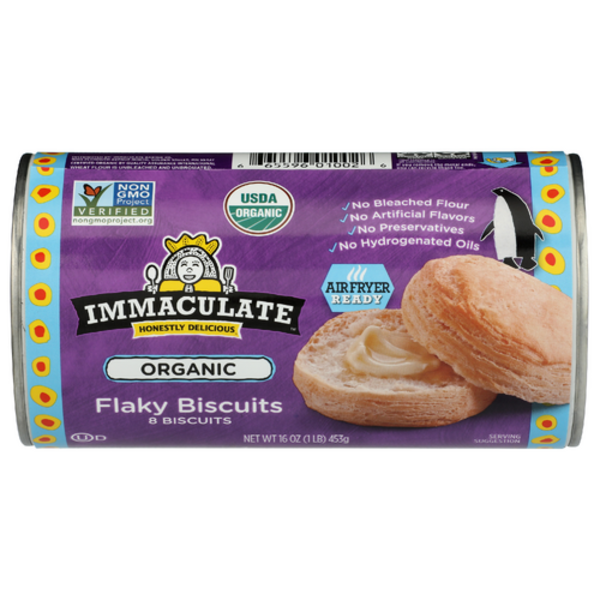
Like mochi, these bookend my daughter's day as her breakfast of choice.  They are technically organic, but I don't love that each one costs $0.93, they generate 45 grams of packaging trash, and contain palm oil.  My first attempt to DIY was to use a Mary Jane's Farm buttermilk biscuit mix.  These were an improvement in only generating 18 g of trash and not using palm oil.  I also loved that this got me started using my skillet/dutch oven on the stovetop for baking projects.  I had been spooked by the MJF bakeover recipes which called for putting the skillets in an actual oven because my little micorwave/convection cannot fit large pans like that.  However, this will not be my final destination for copycat pop can biscuits.  These turned out tasty and stick-to-your-ribs savory, but were less of a laminated flaky pastry that is easy to break open and smother in chocolate hazelnut spread.  They also work out to be more expensive to source from Idaho.  That said, this was so educational, I am glad I gave it a try and believe I can track down the recipes to make similar bakeover mixes in Mary Jane's cookbook but using responsibly harvested ingredients that are sourced closer to home.   


Community Service Log

 Start a Community Service Journal.  Write a quick synopsis of what you did, and don't forget to record how many hours or minutes you volunteered.  To complete this [beginner] badge, you must donate a total of 10 hours of service. 


Total:  25 hours | 2 hours @ food shelves | 0 hours @ community gardens

1/19/2026:  2 hours.  Fallon and I helped on an assembly line to fill 571 cardboard boxes of shelf-stable items for food-insecure families on MLK day.  We signed up with my Quaker meeting, but ended up in the thick of a very sweet group of ladies who seemed to be part of some sort of fraternity/sorority/greek organization and very supportive of what little Fallon could find to do (and conversely, what I could find that was close to her).  My curious side wondered where/how they procured so many palettes of uniform food to do an assembly line.  My critic couldn't help thinking that there were more nutritionally-dense and cost effective options than cereal and juice.  How do food insecure families get fresh veg?  Fallon ultimately had fun but was hoping to be more "customer" facing in her service work.  [Parking Partners MLK, organized by OC Friends Meeting]

1/22-1/23/2026:  3 hours.  School parent group treasurer.  This was time spent doing 7 years of back book-keeping to file 10 forms the CA Department of Justice needs in order to remove our 501(c)3 suspension.  Then an excursion to the post office to mail it.  Generally, I sneak this sort of volunteer work in around the edges and don't track my hours, but this project was so big I started doing 25 minute "pomodoro" timed sessions to chip away at it.  

1/23/2026:  0.5 hours.  School parent group treasurer.  Building a prepayments list for the book sale this coming week and setting up email forwarding.  

1/24/2026:  1.5 hours.  Girl Scouts mega cookie pickup and caravan to our cookie coordinator's house.

1/26/2026: 1 hour.  Parent group at school- helping sort books for the book fair.  

1/26/2026: 0.5 hour.  Parent group treasurer building list of Venmo prepayers for the book fair.  

2/9/2026: 1 hour.  Parent group treasurer.  Book keeping bank statements and calculating the book fair revenue. 

2/11/2026: 1 hour.  Helping room parents with a Valentine's day party.  Throwing balls at a target and helping the first graders add up the total.

2/13/2026: 2 hours.  Facilitating girl scout meeting.  

2/24/2026: 1.5 hours.  Girl scout service unit leads meeting.  

3/2/2026:  1.5 hours.  Parent group treasurer.  Sorted payments for 2 activities, paid 2 bills, email correspondence.  

 3/4/2026:  2 hours.  Parent group treasurer.  Sorted payments for 3 activities, paid another 3 bills, balanced the books.  

3/10/2026:  0 hours.  OC Public Library-Tustin.  Submitted application to help shelve books at the library.  

3/11/2026:  4 hours.  Parent group volunteer.  Cooked 3 casseroles, loaned 2 folding tables + picnic blanket, and assisted at the "invisible ink" station during the Revolutionary War festival.  

3/13/2026:  3 hours.  Girl Scout troop leader.  Helped facilitate the meeting and prepared all the fixings for a "Taco Factory" assembly line snack.  

3/16/2026:  .5 hours.  Parent group treasurer.  Bill pay for middle school dance and list pull for field trip payments.  


Research and write down three community organizations you could help by donating your time.  Choose one and find out how to volunteer.  

1.  OC Public Libraries The services provided here are so great.  It is the main way I can feel "rich" without needing to spend much and I'd love to give back for all the labor I've generated putting in book holds, and reshelving.  In addition, this branch is very convenient to many of our extracurricular activities.      [applied 3/10/2026]

2.  City of Santa Ana Parks & Rec Community Garden This is walking distance from our house and helping here feels very reminiscent of an element of my favorite video game (Stardew Valley).  Fallon is interested in gardening and engaging with others on gardening topics.  I have some training with Master Gardeners and 9 years of volunteer experience there, but am letting my volunteer status lapse because I felt I needed to find a way to help out that was more complementary to parent life and hopefully reconnect with them in my empty nester season.  This space is also exciting for me because I am learning Spanish, but need more opportunities that nudge me to practice with fluent speakers.  

3.  Meals on Wheels/Tustin Senior Center:  Fallon wants to get more involved in food distribution and this place is somewhere her troop has been visiting for Christmas and in a convenient location to our regular extracurricular stomping grounds.  Hanging out with seniors is fun.  

4. [current] School Parent Group (Treasurer):  already involved, significant source of hours.  I am earning about nonprofit book keeping and how to revive a suspended nonprofit status.  

5.  [current] Girl Scouts (Troop leader):  I offered to co-lead as a way to stay in touch with some of my daughter's besties from preschool as they disbursed to different kindergartens.  They're in their 3rd year as a troop now.    

6.  OC Animal Care:  Scouts are planning to visit later this month.  When I asked sisters what types of volunteering they like to do, working with pets was top of their list.  

Tuesday, January 6, 2026

Bee Good to Your Mother Earth

Grow a vegetable garden, even if its just one zucchini plant!

We just put in 3 sets of Dixondale Texas Legend onions!  


Don't use any pesticides and synthetic fertilizers in your garden, or stop using them if you currently use them. 

I use pesticides pretty judiciously and look for the least toxic option.  The mainstays I am unwilling to give up are both organic approved:  1.  Bti a bacterium I put in areas that have chronically standing water because the Aedes mosquitoes that have moved into our region are very difficult to suppress.  2.  Bonide horticultural spray which I will use to eliminate scale which ants were repeated installing for its honeydew secretion on a prized Akebia vine and an indoor staghorn fern mealybug infestation.  For the rest of the garden, I scrape them off and celebrate lady bug larva sightings.  

On the fertilizer front, we don't fertilize much of our outdoor orchard or yard.  We hope that compost, compost tea, and mulch are enough to maintain favorable growing conditions.  On the houseplants and potted plants, I have experimented with kelp extract, Osmocote (not organic), and Miracle-Grow (not organic).  It may take several years to use their tiny containers at the application rate I use, but when I deplete the non-organics, I will replace them with Plant-Tone (as suggested by Nancy Goodwin) or other organics.  

Research organic pest control

I've had some great success taking photos of problems and asking ChatGPT to diagnose them (i.e. rust on roses, mealy bug on Staghorn).  But I generally sanity check general internet advice with my local cooperative extension's IPM website before taking action.  While integrated pest management isn't purely organic, it advocates for chemical controls as a last resort: 

" Chemical control is the use of pesticides. In IPM, pesticides are used only when needed and in combination with other approaches for more effective, long-term control. Pesticides are selected and applied in a way that minimizes their possible harm to people, nontarget organisms, and the environment. With IPM you'll use the most selective pesticide that will do the job and be the safest for other organisms and for air, soil, and water quality; use pesticides in bait stations rather than sprays; or spot-spray a few weeds instead of an entire area." 


Read Montrose: Life in a Garden by Nancy Goodwin

I had my doubts about this initially.  Nancy is focused on ornamentals in zone 8a while I am focused on edibles in zone 10b.  There seemed to be quite a hullabaloo about dragging things into and out of green houses, jerry-rigging cold frames and mourning the loss of tropical plants to frost which grow like weeds around here.  Yet I found a kindred spirit in the struggles of caretaking an historic property, coexisting with a neighboring elementary school, admiring the Bloomsbury group creatives, desperate strategies for keeping cool working in the heat and hydrated during droughts, and befriending feral cats.  

She seems to have a massive work ethic.  She is out gardening until 6 PM.  She got 10 hours of daylight and spent 8 of them in the gardens.  I feel gassed after 10 minutes.  I wonder how to build my endurance up and suspect that part of it is leaning into something one finds deeply interesting and part of it is the fellowship of her husband and 4 staff "body doubling" alongside her.  

I still wonder about her process.  It seems she took notes on her activities daily but summarized them monthly for the sake of the book.  Perhaps I could adopt a similar approach.  She seems to have maintained quite an archive as the diary is littered with comparisons about plants emerging early or late relative to past years.  Although soporific reading, I am impressed by her precision with scientific names.  It reminded me a bit of the Garden of Eden in Genesis and Adam and Eve's only job was to stroll around naming things.  It also seemed to assert that the "audience" for this text was future Nancy and her staff rather than going out of her way to onboard us bystanders.      

Does anyone else struggle with reconciling artistic drawings of plants with their real life appearance?  I find I favor seed catalogs that use photographs of the plant rather than artwork and only after I can recognize a plant on sight do I feel I can appreciate an artist's rendering of it.  Still give Ippy kudos for honing her illustration skills.  Now I know to try warm water and isopropyl alcohol to preserve cut flowers if I try my hand at it as well.  It seems like a satisfying meditative activity.  

Kingsolver mentioned in Animal, Vegetable, Miracle that east coast gardening is about removing the unwanted while west coast gardeners start with a blank slate and water what they want into existence.  Goodwin sees it as "set design" and the change in perspective not by what we add but what we remove.  (pg 79).    

In terms of organic gardening, it seems she is not a purist.  She swears by Plant-Tone fertilizer, which is organic, makes and constantly reapplies a home brew tabasco deer repellent and  seems to be importing a lot of leaves to supplement her compost pile.  All very organic.  She also swears by Miracle Gro fortnightly in her pots through their blooming season, which gave me pause as I am not nearly so heavy handed with Osmocote on my potted house plants.   

Other favorite quotes: 

"A plant that grows well enough to see its own seedlings is in the right place." 48

"I feel uneasy being in style."  59

"I organize every day around weather reports." 144

"I feel a slight unease if I don't work outside for at least part of each day." 262